

Last Updated on October 20, 2026 by Umar Farooq
A downspout drain under patio pavers is doable, and it is the cleanest fix when the downspout sits right at the patio edge. Use solid, smooth-wall pipe (not perforated, not flimsy corrugated), lay it with at least 1/8 inch of fall per foot toward an outlet 10 feet or more from the house, and put a catch basin or cleanout where the downspout drops in. Bury it about 12 inches down so it clears the paver base, and backfill the trench in thin, compacted lifts so the pavers above don't dip along the line. For the full picture, see catch basin patio.
Roof water is the one source of patio water you can remove completely, and it is surprisingly rude about being ignored. For the wider picture of slope, grading and other drain types, start with patio drainage.
Under the patio or around it?
Before you dig, ask whether the pipe has to go under the pavers at all. A line that skirts the patio edge is easier to inspect, easier to repair and costs you no pavers. Go under only when the downspout lands mid-patio, the patio is boxed in by a wall or house on two sides, or the only fall to daylight crosses the paved area.
Here is my one firm opinion on this: a buried pipe you can't reach is a future headache, so give it a cleanout and a route that is easy to find, or don't put it under the patio. Pavers are loose units, so a strip can be lifted and relaid if the pipe fails. But that is a Saturday, and it is the Saturday you were planning to spend sitting on the patio.
Call 811 before any trench. Engineer Fix's guide to burying downspouts and Journeyman HQ both flag it, and the house side of a patio is exactly where service lines tend to run.
Pick solid pipe, and keep it smooth
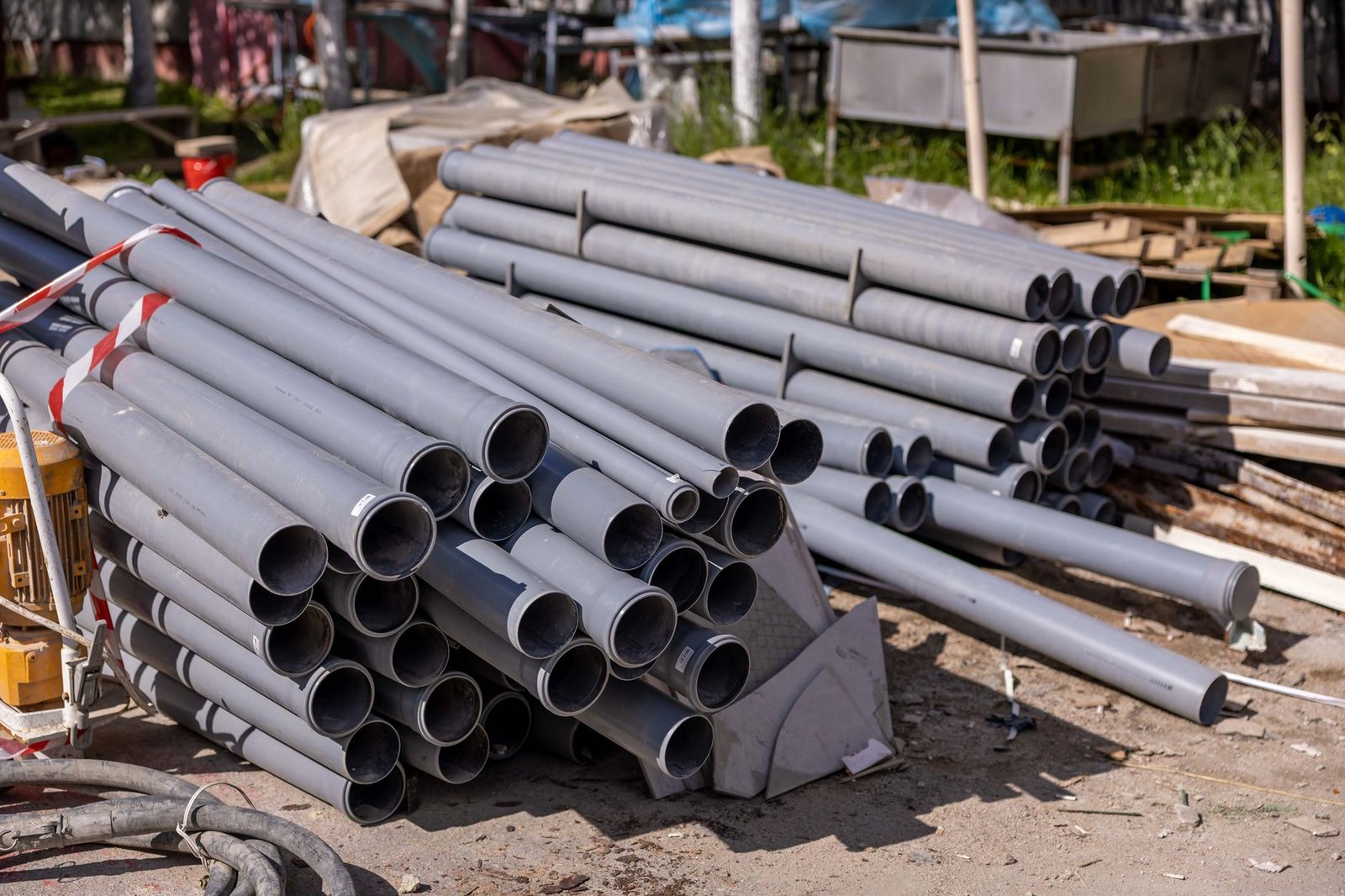
Three kinds of pipe come up, and the sources I read agree on the verdict for a line that runs beneath hardscape.
| Pipe | Good for | Problem under a patio |
|---|---|---|
| Solid smooth-wall PVC (Schedule 40 or SDR 35) | Runs under patios and walkways | Needs glued joints and careful bedding |
| Solid corrugated tubing | Long lawn runs, flexible | Ridges trap sediment, thin walls crush or get root-invaded |
| Perforated pipe | French drains in soil | Leaks roof water exactly where you don't want it |
KG Landscape, a Minnesota drainage contractor, says it uses solid PVC under patios, walkways and other hardscape, and keeps the first 15 feet or more from the house non-perforated. Journeyman HQ's burial methods rundown recommends smooth-wall PVC for the same reason: the smooth interior resists debris buildup.
Glue every joint with solvent cement. A leaking joint under a patio sends roof water into the base, which is how you end up with base washout and a patio that slowly leans toward the leak.
Depth and fall under the pavers
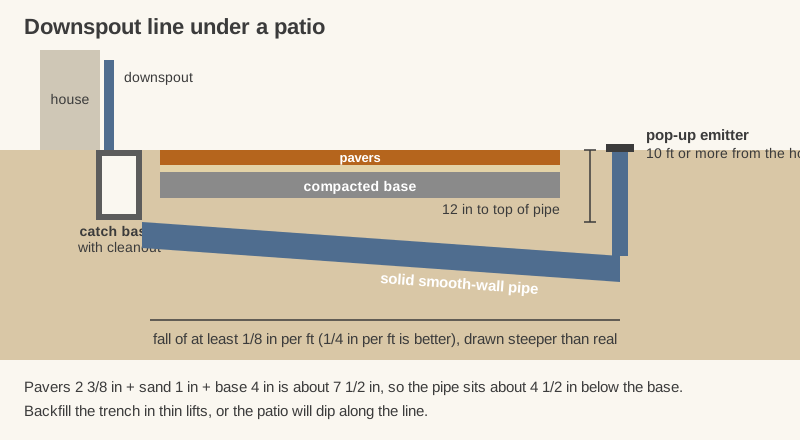
The numbers the sources give:
- Depth. Engineer Fix says 12 to 18 inches generally gives enough cover. Journeyman HQ asks for at least 6 to 8 inches of compacted soil over corrugated pipe so it doesn't crush.
- Fall. Engineer Fix gives 1/8 inch per foot as the minimum and 1/4 inch per foot as preferable. Journeyman HQ also lists 1/8 inch for smooth PVC but asks for 1/4 inch for corrugated. Where they differ, take the steeper number.
Now the arithmetic, which is mine and not a source's. A typical patio build is 2 3/8 inches of paver, 1 inch of bedding sand and 4 inches of compacted base, about 7 1/2 inches in all (see paver base). Put the top of the pipe 12 inches down and about 4 1/2 inches of undisturbed soil sits between base and pipe. Over a 25-foot run, 1/8 inch per foot is about 3 inches of drop and 1/4 inch per foot is about 6 inches.
Set the grade with stakes and a string line, and run water through the pipe before you backfill. If it chokes on a garden hose, it will choke on a thunderstorm.
The trench backfill is the weak spot
Disturbed soil settles, and the pavers follow it down. Journeyman HQ lists uncompacted trench soil as a common cause of low spots, while Engineer Fix warns that over-tamping can crack the pipe. So do both halves properly: bed the pipe in sand or fine stone, then backfill and compact in thin layers by hand tamper rather than slamming a plate compactor straight onto the pipe crown.
If a dip shows up later, the repair is the same as for any sunken area. See how to fix sunken pavers, and treat the pipe as a suspect before the sand.
Catch basin, cleanout and leaf strainer
Roof water brings grit, shingle sand and the odd leaf, and a solid pipe will happily fill with all three.
KG Landscape sets a 12 by 12 inch catch basin under each downspout, with a removable grate and a built-in trap that lets sediment settle, so debris stays out of the pipe. Engineer Fix suggests a cleanout Y-fitting near the house for the same reason, and Journeyman HQ prefers 45-degree wyes or long-sweep elbows over sharp 90-degree tees, which snag debris.
Put the access point before the pipe goes under the pavers, not after. Under the patio is the worst place to discover you need to rod a clog.
Where the water comes out
The outlet decides whether the whole line works. The options, from the sources:
| Outlet | Needs | Watch for |
|---|---|---|
| Daylight (pipe ends on a slope) | A continuous downhill grade | Fails in flat yards |
| Pop-up emitter | A low spot in the lawn, lid that opens under flow | Can freeze with trapped water; Journeyman HQ drills a 1/4 inch weep hole in the elbow beneath it |
| Dry well | Soil that drains | Journeyman HQ warns against dense clay that won't drain within 24 to 48 hours |
| Storm sewer | Local approval | Engineer Fix calls it heavily regulated, often needing a permit |
Distances disagree a little. Engineer Fix and Journeyman HQ say 10 feet or more from the foundation, while KG Landscape's FAQ says at least 15 feet. Take 15 if your lot allows it. KG Landscape also warns against discharging onto a neighbor's property, so aim the outlet at your own ground.
Past the outlet, the ground should keep falling away from the house. The IRC's model rule (R401.3) calls for at least 6 inches of fall in the first 10 feet. Check with your local building department.
Mistakes that bring the puddle back
- Tying into perforated pipe. Roof water leaks out of the holes next to the foundation, the opposite of the goal.
- No access point. You can't clear what you can't reach.
- Backfill that isn't compacted. The patio develops a ditch-shaped dip.
- Outlet too close. Water walks back to the house.
- Flat or reversed fall. Pipe with no fall holds water, and in winter it freezes.
Pipe it around if you can, under if you must
The best buried downspout line is the one you never have to dig up. Go around the patio where the layout allows, and when you go under, use solid smooth pipe, a cleanout before the pavers, 1/8 inch of fall as a floor, and an outlet well clear of the house. Then sit on the patio during the next storm and enjoy watching nothing happen.
FAQ
Can you run a downspout drain under a patio?
Yes. Use solid, glued smooth-wall PVC, give it at least 1/8 inch of fall per foot to a daylight, pop-up emitter or dry well outlet, and add a cleanout before the pipe goes under the pavers.
How deep should a downspout pipe be buried?
Engineer Fix gives 12 to 18 inches as generally sufficient. Under a patio, about 12 inches puts the pipe roughly 4 1/2 inches below a standard 4-inch base, by my arithmetic. Corrugated pipe needs at least 6 to 8 inches of compacted cover per Journeyman HQ.
How far should a downspout drain from the house?
Sources range from 10 feet (Engineer Fix, Journeyman HQ) to at least 15 feet (KG Landscape). The farther the better, as long as the water doesn't reach a neighbor's yard.
Should a buried downspout pipe be perforated?
Not near the house or under a patio. KG Landscape keeps the first 15 feet or more solid and uses perforated pipe only in a French drain section farther out.
Do I need a cleanout on a buried downspout line?
Yes. A cleanout Y-fitting near the house, per Engineer Fix, lets you flush grit and leaves, and it saves lifting pavers to reach a clog.
Will a buried downspout line make the patio sink?
Only if the trench backfill isn't compacted or a joint leaks. Bed the pipe, backfill in thin lifts, glue every joint and test with water before the pavers go back.


