


Last Updated on October 20, 2026 by Umar Farooq
Decomposed granite base for pavers is not what paver installation guides call for. They ask for compacted crushed stone with a limited amount of fines, and decomposed granite (DG) is almost all fines. DG is a fine material for a garden path or, in some guides, for the joints between natural stone, but under concrete pavers the safer base is dense-graded crushed stone.
The top pages for this keyword are thin: I measured about 850 and 700 words, so this article is deliberately short too. Two of the sources are sellers, one of them selling a competing product, and I've said so where it matters.
What decomposed granite is, and why fines decide everything
DG is granite broken down into small particles plus fine dust. Earthstone's guide says the dust fills the gaps between particles, so it "compacts into a firm surface" that is pleasant to walk on. The same fines are why it drains only moderately: crushed gravel drains faster, and DG can be dusty when dry.
For a path that is a fair trade. For a paver base, it is the wrong trade, because the base's job is to carry load and let water out. Polycor's installation guide asks for a dense-graded crushed stone base "that does not have too much fines in the mix that it retains water and impedes drainage or could potentially lead to frost heaving," and gives 3/4 inch minus (or No. 78 stone) as the recommended size. Too few fines, it adds, lets bedding sand migrate into the base. So the target is a middle: some fines, not mostly fines.
Why a decomposed granite base for pavers loses to crushed stone
Polycor and Earthstone point the same way. Earthstone's guide recommends compacted road base or crushed rock beneath pavers and flagstone, with a DG path or patio sitting over a compacted base rather than replacing it. Polycor wants at least 4 inches of compacted base under a patio on well-drained soil, compacted with a vibrating plate of at least 5,000 lbf. Our paver base material and crushed stone size for pavers pages cover what to buy, and paver base covers depth.
Where decomposed granite fits around pavers
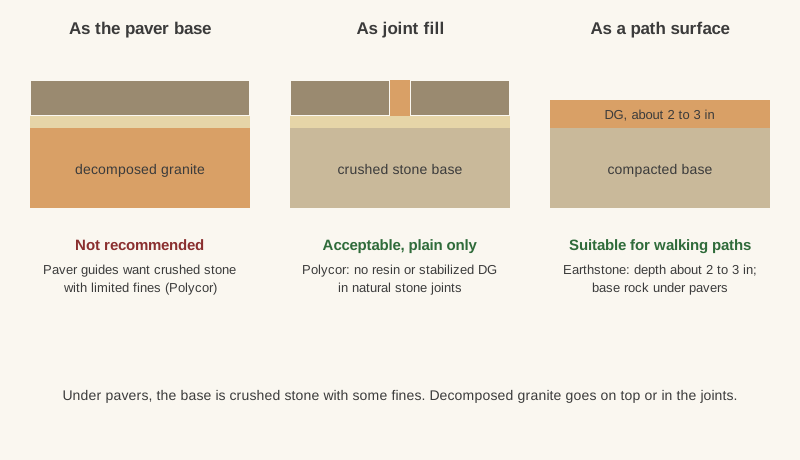
DG has two honest jobs near pavers. The first is joint fill. Polycor's guide says concrete sand is sufficient for natural stone joints and "decomposed granite is also an option," with one condition: do not use DG with resins or stabilizers there. The second is a walking surface: Earthstone figures DG paths at about 2 to 3 inches deep, over a compacted base.
For concrete pavers, joint sand is a different question, and we cover it in stone dust vs polymeric sand and sand for pavers.
The vendor case, and why I can't back it
Several vendor pages describe DG as an excellent paver base, with figures for moisture and stabilizers. I couldn't open them (they returned 403), and the summaries I saw gave no standard base depths or compaction specs for DG. I am not going to repeat claims I can't read. The documents I could open, from the paver side, say crushed stone.
I also looked for a paver maker or standards document that specifies a DG base. I did not find one in the sources I opened. If you are working from a contractor's quote that lists DG as the base, ask for the paver manufacturer's installation guide and compare.
Stabilized DG is not a base fix
Stabilized DG, with a binder mixed in, comes up because loose DG migrates. TRUEGRID, a company selling plastic cell grids, says unstabilized DG spreads, ruts and puddles, and compacts until nearly impermeable. That is a product pitch, but the loose-surface problem is real. It does not turn DG into a paver base. Polycor warns against stabilized DG in natural stone joints, and for the base layer I found no paver document that asks for it.
Crushed stone under, DG on top or in the joints
If you want one rule: under pavers, crushed stone with some fines, compacted in thin lifts; decomposed granite on the surface of a path or, per Polycor, in natural stone joints. Pick the material for the layer, and the patio will thank you slowly, over about ten winters.
FAQ
Can you use decomposed granite as a paver base?
It is not recommended. Paver installation guides, including Polycor's, call for compacted crushed stone with limited fines, because too many fines hold water and can lead to frost heave. Decomposed granite is almost all fines.
Is decomposed granite better than crushed stone under pavers?
Not from the sources I could open. Earthstone says crushed gravel drains faster and recommends road base or crushed rock under pavers. DG's advantage is a firm, walkable surface on a path.
Can I use decomposed granite between pavers?
Polycor's guide lists it as an option for joints between natural stone, as long as it has no resins or stabilizers. For concrete pavers, follow the joint sand guidance in our sand articles.
What depth does decomposed granite need?
Earthstone puts DG paths at about 2 to 3 inches over a compacted base. Under pavers, the base should be at least 4 inches of compacted crushed stone on well-drained soil (Polycor).
Does stabilized decomposed granite work under pavers?
I found no paver guide that calls for it. TRUEGRID discusses stabilized DG for driveways, and Polycor says not to use stabilized DG in natural stone joints.


