Last Updated on October 20, 2026 by Umar Farooq
Slippery algae on pavers is a thin, wet film that grows wherever the surface stays damp and shaded, and it can make a paver as slick as ice before it looks bad enough to bother you. The fast fix is to keep people off the spot, sweep it, scrub it with a stiff nylon brush and rinse it gently. The lasting fix is to find the damp spot that feeds it, because the film comes back wherever the water does.
This page is about the slipperiness and its cause. For the cleaning recipes themselves, the site's moss-cleaning guide and its bleach on pavers page already cover the details, so I will not repeat them here.
Is it slippery algae on pavers, or something else making them slick?
Several things make a patio slippery, and they need different fixes. Walk the surface and compare.
| What you see and feel | Likely cause | Where to go |
|---|---|---|
| Green, brown or black film that feels slimy when wet | Algae | This page |
| Thick, soft green cushion, gritty or fluffy | Moss | Clean moss off pavers |
| Crusty, flat patches that scrape off in flakes | Lichen | Lichen on pavers |
| Even shine, not green, slick only when wet | Gloss sealer or worn smooth finish | Slip resistant pavers |
| Rust-orange or mineral streaks near sprinklers | Irrigation stains, not growth | Different cleaner |
Dream Outdoor Living describes algae on pavers as green or brown and slimy, and says a rough, gritty feel points to moss or mold instead. WC Pavers, a Florida paver-care company, adds that mold looks dark and patchy and that irrigation rust and mineral deposits need different treatments. Neither gives a way to tell them apart with certainty, and I found no source that does. A lab can. The rest of us look and feel.
A quick test, which is my own suggestion rather than a published method: scrape a small spot with a dull putty knife. Oregon State's extension guidance recommends a dull blade for clearing growth. If a slimy film lifts off and the paver underneath is rough and grippy, it was algae. If the surface stays glassy after scraping, look at the finish, not the growth.
Make it safe today, before you clean it
Green growth can make a surface slippery before the staining looks serious, according to WC Pavers, which advises restricting access to slippery areas while you work, especially at entrances and pool decks. That is the right order: warn people, then clean.
- Route traffic around it. Use another path, or lay a note where people will see it.
- Clear the busy spots first. Oregon State's moss guidance says to clear the heavily walked spots first, and the same advice suits algae.
- Sweep off leaves and debris. WC Pavers and Dream Outdoor Living both start here, because leaf litter feeds growth.
- Scrub with a stiff nylon brush. WC Pavers says to avoid wire brushes. The Royal Horticultural Society, a UK source, suggests a wire brush on hard surfaces, so the advice differs. For pavers, I would side with nylon, because wire can scratch the surface and the joints.
- Rinse with a broad hose spray. WC Pavers says to stop if sand collects in the runoff, which means the joint sand is washing out.
Soap or cleaner left behind makes the same slick film that algae does. The site's slip-resistance page notes that soap film and thick gloss sealer fill the texture that gives a paver its grip, so rinse thoroughly and let the surface dry before you call it safe.
Where the algae lives: five damp spots to check
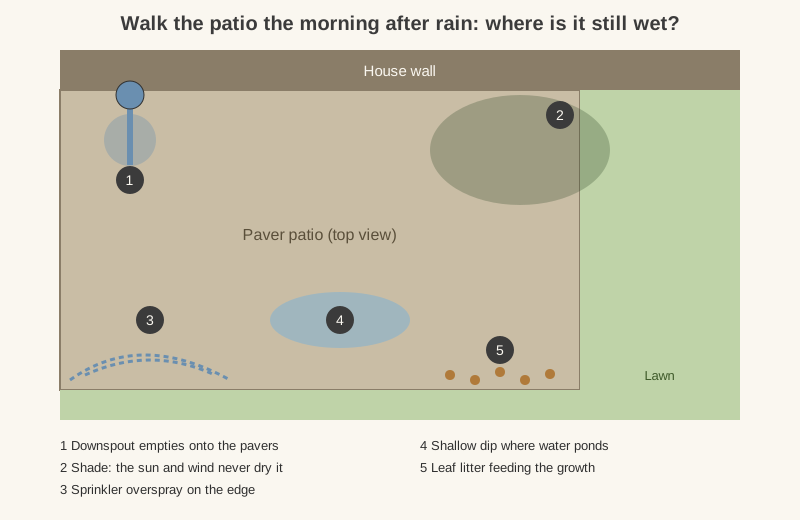
Oregon State's extension guidance says algae grows on walls, sidewalks and patios in shady locations, and the Royal Horticultural Society says growth is faster in shaded spots with poor airflow. UC's Statewide IPM Program says algae and moss thrive under damp conditions and recommends redirecting downspout water away from hardscape. WC Pavers lists irrigation overspray, rain, debris and humidity as the usual feeders.
Walk the patio the morning after rain or irrigation and look for the spot that is still wet or green:
- A downspout or roof runoff landing on the pavers. Pipe it away from the patio instead.
- Shade from a tree, a fence or the house itself.
- A sprinkler whose arc clips the edge. UC IPM suggests longer gaps between irrigations where plant health allows.
- A dip where water ponds. A shallow puddle that lasts a day is a base problem, and the patio drainage guide covers fixing the fall.
- Leaf litter or soil washing onto the surface.
One thing surprised me. UC IPM says that increasing light around plants can reduce moss, but it may stimulate lichens and sometimes algae. So cutting a branch is worth doing for airflow and drying, but it is not a guaranteed algae fix.
A study worth knowing about, and what it did not test
I went looking for research on why paving gets slick and found one peer-reviewed paper. Munyai and colleagues examined algae-covered brick pavement at the University of Venda in South Africa and found much higher metal levels, such as iron and zinc, in algae-covered bricks than in clean ones. They attribute the slipperiness to algal mucilage, the slimy coating, but they did not measure slip resistance, did not identify the algae species and sampled only six bricks, so the study shows an association, not a cause. I would not change brands because of it.
Kill it, scrape it, then dry the spot out
The extension sources disagree on method, so I will say where. Oregon State lists pressure washing as effective for patios and sidewalks, and lists moss-killing soaps and scrubbing, but gives no bleach recipe. UC IPM mentions herbicidal soaps for walkways where growth is a slipping hazard and says to follow the label. WC Pavers warns that pressure washing can strip joint sand, and the sources on the bleach page warn that bleach can lighten color and strip sealer. The site's bleach page gives ratios from about 1:48 to 1:3 from three sources, so the spread is real.
My order, cheapest and most reversible first:
- Dry brush and scrape the loose growth.
- Scrub with water and mild soap, rinse well.
- Use a cleaner labelled for algae on your paver, following its label and testing a hidden spot.
- Pressure wash only at the lowest effective pressure with a wide fan, and stop if sand washes out.
Do not mix cleaners. WC Pavers cites CDC guidance against mixing bleach with other cleaners because of dangerous vapors.
After cleaning, check the joints. If the sand washed out, top it up before the next rain.
What will not hold: cleaning without fixing the water
Cleaning is a reset, not a cure. The Royal Horticultural Society states that algae, lichens, liverworts and mosses return if growing conditions stay unchanged, and WC Pavers makes the same point: cleaning alone will not correct persistent moisture. One extra drain can be worth more than three cleanings. The RHS suggests shallow gravel channels along the edges of patios to absorb runoff; that is a UK garden source, so check whether it suits your soil.
I could not find a source that proves sealing stops algae from returning. Several paver-care pages recommend it, but without data, so treat it as a maybe. And a sealer that adds gloss can make a clean patio slicker, so see the gloss section of the slip-resistance page above.
When to stop and get help
- Steps, ramps and pool decks. A slick spot here is a fall risk, so keep it closed until it is clean and dry. If someone has already slipped, fix the cause before anyone uses it again.
- A dip that holds water for days. The pavers sank, and cleaning will not lift them. That needs a base repair.
- Near plants, a pool or storm drains. Follow cleaner labels and keep runoff out of waterways; both UC IPM and Oregon State say so for the products they list.
- Loose, rocking pavers. Those are a trip hazard on top of the slip hazard.
Dry beats clean
A patio that dries quickly stays safe. Scrub the film off, redirect the water that keeps feeding it, and let the sun and wind finish the job. Treat the slime as a symptom and the damp spot as the problem. And if the patio ever looks cleaner than your car, resist the urge to celebrate on it in socks.
FAQ
Is algae on pavers dangerous?
It can be, mainly as a slip hazard. Oregon State and UC IPM both say algae on walkways and hard surfaces makes them slippery and unsafe for walking.
How do I make slippery pavers safe quickly?
Keep people off the spot, sweep it, scrub with a stiff nylon brush and rinse with a gentle broad spray. Let it dry before using it. Then find what keeps it damp.
Why do my pavers get slippery when wet?
Often algae, which grows where water stays on shaded pavers. A gloss sealer or a worn smooth surface can also do it. Scrape a test spot: a slimy film that lifts is algae.
Will algae come back after cleaning?
Yes, if the damp conditions stay the same. The Royal Horticultural Society says these growths return when conditions are unchanged, so fix the downspout, shade or dip that feeds it.
Can I pressure wash algae off pavers?
Oregon State calls pressure washing effective for patios. Paver-care companies warn it can wash out joint sand, so use the lowest effective pressure, a wide fan and stop if sand appears in the runoff.
Is it algae or moss?
Algae is a thin slimy film, usually green, brown or black. Moss is thicker and softer, and it grows in joints and textured spots. The site's moss and lichen pages cover the other two.