
Last Updated on September 23, 2026 by Umar Farooq
Paver bricks are brick-shaped paving units, usually about 4 by 8 inches, made either from fired clay or from dry-cast concrete. Clay paver bricks keep their color for life because the color is fired right through the unit. Concrete brick pavers, including the classic 4 x 8 "Holland stone," come in far more colors and sizes and are more common. Both are laid the same way, on sand over compacted gravel, and both last for decades when the base is right. (The word "brick" on a pallet tag, I have learned, promises a shape. It promises nothing about whether that shape survives a winter lying flat.)
For the wider family of materials, including natural stone and porcelain, start with our overview of paving stones.
A wall brick is not a paver brick
Store listings for "bricks and pavers" mix two products.
- Paver bricks are made to be walked and driven on. Clay pavers in the US are made to ASTM C902 (pedestrian and light traffic) or ASTM C1272 (heavy vehicular). They are solid, dense and rated for freezing while wet.
- Building bricks are made for walls. Many have holes (cores) and aren't tested for foot traffic, abrasion or de-icing salt.
Reclaimed wall brick looks charming in a patio for a few winters, then the faces flake. If the pallet does not say "paver" or list a paving standard, keep it for the garden wall.
Clay paver bricks vs concrete brick pavers
"Pavers or bricks?" Both are pavers. The real choice is clay or concrete.
| Clay paver bricks | Concrete brick pavers | |
|---|---|---|
| How it is made | Clay or shale, molded or extruded, then kiln-fired | Cement, sand, aggregate and pigment, pressed in molds and cured |
| Color | Fired through the body; does not fade | Pigment in the mix; the surface can lighten as it wears |
| Color range | Mostly reds, browns, buffs and grays | Very wide, including blends |
| Sizes | Mostly around 4 x 8 in, plus a few squares | 4 x 8 up to large slabs, plus many shapes |
| Strength standard | ASTM C902 or C1272 | ASTM C936 |
| Edges | Crisp or tumbled; can chip if struck | Usually chamfered; chips show gray inside if the color is only in the face mix |
| Sealing | Not needed for color | Optional, often used to enrich color |
The Brick Industry Association says the color of a clay paver is "fired through the body of the unit" at almost 2,000°F and that most clay pavers exceed 10,000 psi in compressive strength, on its clay pavers page. Concrete pavers made to ASTM C936 must average 8,000 psi, with no unit under 7,200 psi and average absorption of no more than 5% (CMHA guide spec), so both are far stronger than a poured patio slab.
Unilock's brick vs concrete paver comparison sums it up: concrete gives you range, clay gives you a narrower palette that stays put.
Holland stone and other rectangular pavers
Holland stone is a concrete paver shaped like a brick. The first concrete pavers were made in this 4 by 8 inch (100 x 200 mm) format and named after the Dutch, who developed interlocking paving in the mid-1940s for their soft, shifting ground.
Most concrete manufacturers still make one. The typical Holland paver has a small chamfer and is 2 3/8 inches (60 mm) thick, the standard for patios, walks and residential driveways. I did the arithmetic because I wanted to know why it has lasted: 8 inches long divided by 2 3/8 thick is an aspect ratio of about 3.4, inside CMHA's 3:1 to 4:1 band for residential driveways. The Dutch got the proportions right the first time, which is annoying for everyone who came after.
Larger rectangles, such as 6 x 12 or 12 x 24, are slabs with their own flatness rules.
Paver brick sizes and thickness
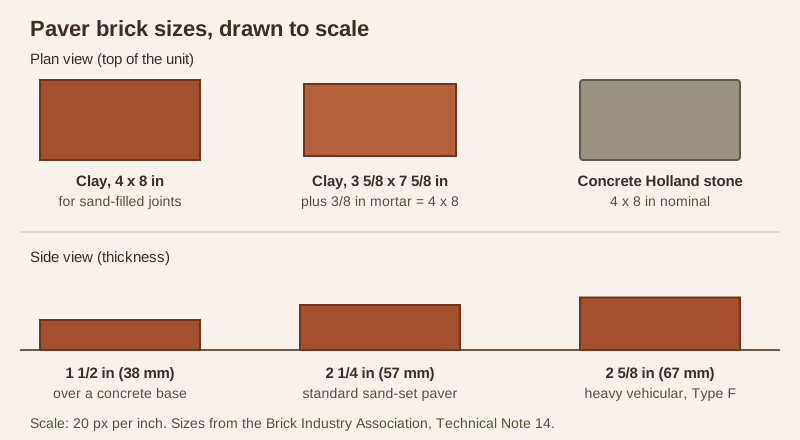
The Brick Industry Association's Technical Note 14 on clay paving lists two common clay paver sizes:
- 4 x 8 inches. Made for sand-set paving with tight joints. Length is twice the width, so they work in herringbone and basketweave without cutting half the field.
- 3 5/8 x 7 5/8 inches. Made for mortared paving. Add a 3/8 inch mortar joint and each unit takes up a 4 x 8 inch module.
Don't mix the two in a sand-set patio; the mortar size leaves gaps.
Thickness. The same note lists common clay thicknesses of 1 1/4, 1 1/2, 2 1/4, 2 5/8 and 2 3/4 inches. For a sand-set patio or walk, use 2 1/4 inches. The 1 1/2 inch units are generally laid only on a concrete base, except for patios and walks in warm climates with little frost. Heavy vehicular clay pavers set in sand (ASTM C1272 Type F) must be at least 2 5/8 inches thick.
Reading the ASTM grade on clay pavers
Clay paver data sheets use three codes. In BIA Technical Note 14 they look like a license plate, but they tell you where a brick can go.
- Class (weather). SX pavers can freeze while soaked. MX pavers are for exterior use without freezing, and NX pavers are for interiors only. Anywhere with a winter, buy SX.
- Type (abrasion). Type I is for heavy wear such as public sidewalks and driveways, Type II for busy residential walks and driveways, and Type III for low-traffic patios and floors.
- Application (looks and tolerance). PS is general purpose. PX has tight dimensional tolerances for patterns such as herringbone. PA allows deliberate variation in size, color and texture for an antique look, and usually wants wider joints or mortar.
For most US homes, the BIA points to Class SX with Type I or II. For a herringbone driveway, add PX.
Where brick pavers shine and where they struggle
Why people choose them
- Color that stays. Decades on, a clay patio is the same red.
- Classic proportions. The 2:1 brick suits older houses and formal patterns.
- Easy repairs. One broken brick can be lifted out and replaced.
- No sealer needed.
What to weigh up
- Limited choice. Few shapes and a warm palette. For gray or large-format looks, concrete wins.
- Chipping. Hard clay can chip if struck or laid too tight, and PA-grade bricks vary enough to make tight patterns fiddly.
- More joints. A 4 x 8 unit means more joints: more sand to top up, more places for weeds.
- Harder cutting. Clay is dense and brittle. Use a wet diamond saw; a splitter leaves a rougher edge on clay.
Laying brick pavers: base, joints and cuts
Paver bricks go down like any other sand-set paver: a compacted gravel base, 1 inch of screeded, uncompacted ASTM C33 concrete sand (stone dust and mason sand won't do), the bricks, an edge restraint, then jointing sand and a pass with a padded plate compactor. The brick doesn't change the base; traffic and soil do: 4 inches minimum under a patio, 6 under a driveway, and 2 to 4 extra on wet or frost-prone ground (ICPI Tech Spec 2). Our paver base guide has the detail.
My one strong opinion here: where it freezes, it's Class SX or nothing. BIA reserves SX for pavers that may freeze while saturated, and MX is rated only for exterior use with no freezing. Water in the pores expands as it freezes, and a brick not built for that sheds its face one winter at a time.
Two brick-specific points:
- Use lugged pavers or string lines. Spacer lugs set the joint; smooth-sided clay bricks need string lines every few courses.
- Pick the pattern for the traffic. Herringbone locks best under cars. Running bond and basketweave suit patios and walks.
For cutting half-bricks and edge pieces cleanly, see how to cut pavers.
Buy SX clay for the look, concrete for the range
If you want real brick that keeps its color for decades, buy Class SX clay paver bricks in the 4 x 8 size, 2 1/4 inches thick. If you want more colors, a gray or modern palette, or a simple Holland stone, a concrete brick paver made to ASTM C936 does the job just as well. Never pave with wall brick. It's a lovely wall. Let it stay one.
FAQ
What is the difference between bricks and pavers?
"Pavers" is the umbrella term for any paving unit set on sand or mortar. A paver brick is one shape of paver, the 4 x 8 inch rectangle, made from clay or concrete. A wall brick is a different product made for vertical use and should not be used for paving.
Are paver bricks better than concrete pavers?
Neither is better overall. Clay paver bricks keep their color permanently and are very strong. Concrete pavers offer more sizes, shapes and colors and are easier to find. Both are durable when laid on a proper base.
What size are standard paver bricks?
Clay paver bricks for sand-set patios are usually 4 x 8 inches and 2 1/4 inches thick. Bricks made for mortar joints are 3 5/8 x 7 5/8 inches. Concrete Holland stones are 4 x 8 inches nominal and 2 3/8 inches thick.
Can you use regular bricks as pavers?
Not reliably. Wall bricks are not made or tested for foot traffic, abrasion or freezing while saturated, and many have holes through them. They often flake or crack within a few winters when laid flat outdoors.
What are Holland pavers?
Holland pavers, or Holland stones, are 4 x 8 inch rectangular concrete pavers, the original concrete paver format. They are a low-cost way to get a brick look in concrete and are about 2 3/8 inches thick.