


Last Updated on October 20, 2026 by Umar Farooq
Black mold on pavers is removed in a fixed order: let it dry, sweep up the dry growth, scrub with detergent and a soft brush, then soak with vinegar if stains remain. Wear a mask and gloves throughout. The three guides I read agree on that skeleton and disagree about bleach and pressure washers, so the gentlest option that works goes first. A power washer is a fine thing to own and a poor thing to reach for first.
Treat all black growth as the dangerous kind
Hunker's guide to mold and algae on brick pavers makes a point I did not expect from a how-to: only lab testing can tell which species you have, so it says to treat all black mold as potentially toxic. Mask on, gloves on, and keep the runoff away from plants.
Brick and concrete are porous, which is why the stuff settles in and stays. Hunker notes that growth peaks in wet weather. The Home Inspection Insider guide adds two sensible rules: keep children and pets off the patch until it is gone, and for a large growth consider hiring a professional.
I found no source that tells you how to tell dangerous mold from harmless algae by eye, so I will not pretend there is one.
Dry it, sweep it, then wet-clean
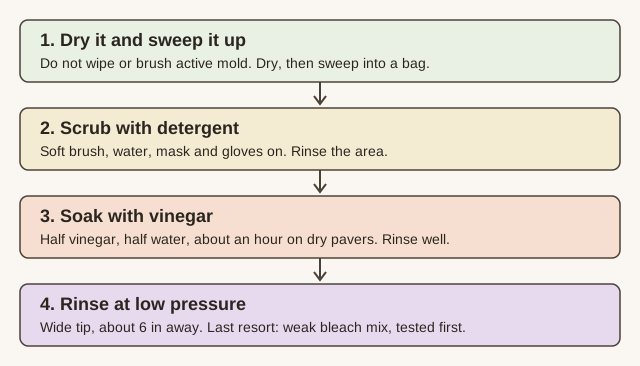
Here is the order I would use, built from the three guides:
- Dry the growth first. Rock Solid Pavers says not to wipe active mold, because wiping spreads it and exposes you to it. Sunny spots dry on their own; for shade, it suggests a blow dryer. Clear cars, planters and boxes so light reaches the surface.
- Sweep the dry growth into a dustpan and bag it. Rock Solid says this stops it reactivating.
- Dampen lightly, just enough to scrub. Don't flood it, or you wash out the joint sand.
- Scrub with detergent and a soft brush. Hunker's third step is plain detergent and a mask. Home Inspection Insider uses mild liquid soap, a few minutes of dwell time and a hand brush, then a hose.
- Rinse and let the sun dry it.
The sources contradict each other at step 1: Rock Solid dries first, Home Inspection Insider scrubs wet. Drying first means less to scrub.
Vinegar: half strength for an hour, or full strength for 15 minutes
If the dark marks survive soap, vinegar is the next rung, and it is the one Hunker prefers. The three sources give three recipes:
| Source | Mix | Dwell time |
|---|---|---|
| Hunker | 50-50 distilled white vinegar and water, or full strength for tough stains | at least 1 hour, on dry pavers |
| Home Inspection Insider | equal parts to clean; undiluted to kill mold | about 15 minutes |
| Rock Solid Pavers | 5% white vinegar in a spray bottle | no time given |
Hunker warns that vinegar is weakly acidic and can change paver color if left on or used undiluted. Test one hidden paver and rinse thoroughly. I would start at the 50-50 mix.
The vinegar side of things has its own page: cleaning pavers with vinegar.
Bleach and pressure washers: where the sources split
Bleach is the real disagreement. Hunker advises against it, saying its high surface tension stops it soaking into the pores. Rock Solid offers 1 cup of chlorine bleach per gallon of water as the alternative to vinegar, and Home Inspection Insider uses 1 cup of bleach per gallon of warm water with 15 minutes of dwell time.
Some arithmetic of my own: 1 cup per gallon is about 1 part bleach to 15 parts water. That is roughly three times the 1/3-cup-per-gallon mix the Concrete Network gives for ordinary mildew, which I cover in bleach on pavers. If you go this route, start weaker than the black-mold guides do, protect the plants and test first. Pale patches are permanent.
Pressure is the other split. Hunker suggests an electric washer around 2,000 psi, a 15 or 25 degree tip held about 6 inches away, and warns that more power chips pavers and that the spray does not reach spores deep in the pores. Home Inspection Insider uses hot water and notes the jet can wash out joint material, so refill afterwards. Both warnings point the same way: use low pressure, expect to re-sand the joints, and read power washing pavers first.
Keep the light on and the water off
Mold returns where it is damp and dim. The prevention advice from the sources is dull and effective:
- Let sun in. Home Inspection Insider says UV helps kill mold and dry moisture. Trim overhanging branches and move furniture so the surface can dry. Rock Solid says the same about removing shade.
- Drain standing water near the patio. If water pools after rain, the fix is underground, and patio drainage is where to start.
- Sealing is optional. None of the three guides I read makes a claim about it, so I will not either. If you do seal, do it for a reason and not because the calendar says so; how often pavers should be sealed explains.
For green rather than black, see the moss page on this site.
Dry first, mild second, bleach last
Black mold on pavers comes off with patience more than force. Dry it, bag it, scrub with detergent, then use vinegar at half strength before anything stronger. Keep pressure low, rinse well and let the surface dry in the sun. Then trim the branch that made the shade in the first place, because a clean patio in the same gloom is only a pause. And if the patch is larger than a doormat, a professional is a reasonable call. The mold does not need a hero, only a bit less shade.
FAQ
What kills black mold on pavers?
White vinegar, used 50-50 with water for about an hour (Hunker) or undiluted for about 15 minutes (Home Inspection Insider), kills it without bleach. Diluted bleach also works according to two sources, while Hunker advises against it.
Is black mold on a patio dangerous?
It can be. Hunker says only a lab test identifies the species, so treat all black mold as potentially toxic. Wear a mask, gloves and eye protection, keep children and pets away, and avoid brushing dry mold hard.
Can I pressure wash mold off pavers?
Yes, with care. Hunker suggests about 2,000 psi, a 15 or 25 degree tip and a 6 inch distance. Too much pressure chips pavers and blows out joint sand, so plan to refill the joints.
Can white vinegar discolor mold-stained pavers?
It can alter color if left on or used undiluted, according to Hunker. Test a hidden paver, keep the dwell time modest and rinse well.
How do I stop mold coming back on pavers?
Add sunlight, keep the surface dry, sweep debris and fix standing water. Trimming shade trees does more than any cleaner.


