

Last Updated on October 20, 2026 by Umar Farooq
Can you pour concrete over pavers? Yes, and the concrete will set perfectly well. The problem is what's underneath. Sand-set pavers sit on a layer of loose sand, so a slab poured on top of them rests on a surface that can still shift and settle one paver at a time, and the concrete tends to crack wherever the pavers move. It also raises the surface by the full slab thickness. If the pavers are firm, level and well drained, a full-thickness slab of about 4 inches can work. If they're sunken or loose, remove them and pour on the base underneath, or relay the pavers. For the full picture, see rodents under pavers. The sunken patio guide covers this in more depth.
Page one for this search is mostly forums and pages about the reverse job, so I built this from the concrete joint guidance and the paver specs instead.
What a slab poured over pavers really sits on
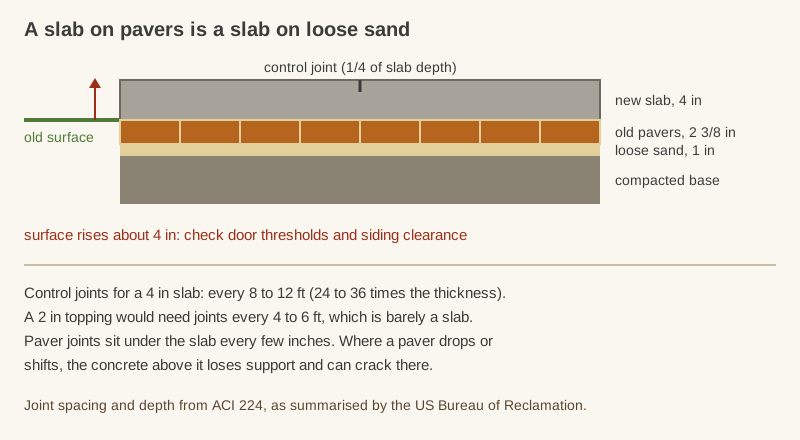
A paver patio is not a solid slab. The pavers rest on about an inch of bedding sand that was screeded and left loose on purpose (ICPI's Tech Spec 2 calls for "an uncompacted nominal 1 in." layer), and they're locked together only by joint sand and an edge restraint. That flexibility is why pavers survive frost and small settlement. Put a rigid slab on top and the two stop agreeing. Where one paver drops a quarter of an inch, the concrete above it loses support, and concrete doesn't bend. It cracks.
It also changes the patio's height. A 4-inch slab on top of the pavers raises the surface 4 inches, which matters at a door. The IRC 2021 (R311.3.1) allows the landing at a required exit door to sit no more than 1 1/2 inches below the threshold, or up to 7 3/4 inches if the door doesn't swing over it, and IRC R317.1 wants wood siding at least 2 inches above a patio surface. Check both before you order a truck. These are model-code numbers, so confirm with your local building department.
How thick the concrete would need to be
The pages that recommend this usually suggest a 2 to 4 inch layer. I'd ignore the bottom of that range, and the joint arithmetic explains why.
Concrete shrinks as it cures and cracks unless it's given planned weak lines, called control joints. The US Bureau of Reclamation's joint spacing review summarises ACI's rule for slabs on ground: space contraction joints at 24 to 36 times the slab thickness, cut about a quarter of the slab deep.
| Slab thickness | Control joint spacing (24–36 × thickness) | Joint depth (1/4 thickness) |
|---|---|---|
| 2 in | 4 to 6 ft | 1/2 in |
| 3 in | 6 to 9 ft | 3/4 in |
| 4 in | 8 to 12 ft | 1 in |
A 2-inch topping needs a joint every 4 to 6 feet, has no reinforcement worth the name, and sits on a surface that moves in 4 x 8 inch pieces. That's a lot of concrete to get a crack pattern. If you pour, pour a full slab of at least 4 inches with welded wire or fibers, and treat the pavers as a base course rather than something to bond to.
If you pour anyway: do it this way
This only makes sense when the pavers are sound: no sunken areas, no rocking units, and water already draining off.
- Check the pavers first. Walk the whole area. Anything that moves or rings hollow gets lifted and reset now; the slab won't fix it later.
- Confirm the height at every door, siding line and adjoining walk. Plan the slab's slope away from the house (2% within 10 feet, per IRC R401.3).
- Clean off moss, sealer and loose joint sand, then fill empty joints so the concrete doesn't key into gaps unevenly.
- Form the edges and add an isolation joint where the slab meets the house, steps or an existing slab, so each can move on its own.
- Place reinforcement on chairs so it ends up in the slab, not lying on the pavers.
- Pour, screed and finish at a full 4 inches or more. A power screed helps on larger pours; see our guide to the vibratory screed.
- Cut control joints to the spacing above within the first day, and cure the slab moist.
Where it goes wrong: pouring over a dip "because the concrete will fill it" (thick spots and thin spots shrink differently), and forgetting that the edge restraint under the slab may be plastic that can't carry a slab edge. Form a thickened edge instead.
The better options: remove, relay or overlay
My honest view: if you want concrete, pour it on a base, not on pavers; if the pavers have a problem, fix the problem. Most paver trouble is local. A dip, a rocking patch or weedy joints are a morning of lifting, re-leveling and re-sanding, and the pavers go back exactly where they came out. That repairability is the whole reason to own pavers. Burying them under a slab throws it away.
| Situation | Better choice | Why |
|---|---|---|
| Pavers sound, you just want a concrete look | Remove pavers, pour on the existing base | Same height as now, slab on compacted stone |
| A few sunken or loose areas | Lift, fix the base, relay | Cheapest fix, keeps the pavers |
| Weedy, sandy joints | Clean and re-sand the joints | Surface problem, not structural |
| Want a new paver surface | Relay or replace pavers | Keeps a flexible, repairable patio |
| Pavers badly settled everywhere | Remove, rebuild base, then decide | The base is the problem under either surface |
Removing pavers is less work than it sounds, and the pavers come up whole; how to remove pavers covers it. The existing compacted base is often usable for a new slab, which also keeps the finished height where it was. If you're going the other way and putting pavers on a slab, that's pavers over concrete.
Pour on the base, not on the pavers
You can pour concrete over pavers, but you're building a rigid slab on a flexible, loose-sand foundation and raising the surface as you go. If the goal is a concrete patio, lift the pavers and pour on the base they leave behind. If the goal is fixing a paver patio, fix the part that failed. Either way, the pavers deserve a better end than being a very expensive gravel layer.
FAQ
Can you pour concrete over brick pavers?
Yes, with the same limits as concrete pavers. Brick pavers on sand can shift under the slab and cause cracking, and the surface rises by the slab thickness. Brick set in mortar on a concrete slab is a sounder base, but the finished height still has to work at doors and siding.
How thick should concrete be over pavers?
If you do it, at least 4 inches with reinforcement, and control joints every 8 to 12 feet. Thin toppings of 2 inches need joints every 4 to 6 feet under ACI's spacing rule and tend to crack over moving pavers.
Should you remove pavers before pouring concrete?
In most cases, yes. Removing them keeps the finished height the same, lets you check and reuse the compacted base, and puts the slab on a stable surface instead of loose bedding sand.
Will concrete stick to pavers?
Fresh concrete bonds poorly to sealed, dusty or mossy pavers, and even a good bond only ties the slab to units that can still move individually. Treat the pavers as a base, not a bonding surface.
Is it cheaper to pour concrete over pavers than to remove them?
It can look cheaper because it skips removal, but you pay for 4 or more inches of concrete plus forms, and you inherit any movement in the pavers. Lifting the pavers is labor, not materials, and they can often be reused or sold.


