

Last Updated on October 20, 2026 by Umar Farooq
When driveway water into garage is the problem, the apron is almost always falling toward the door, or a low spot at the threshold is holding water against it. Check which way the pavers fall before anything else. The cheapest fix is to stop water arriving from uphill, the next is to lift the apron pavers and re-set them with a fall away from the garage, and a drain across the door is the backup, not the cure.
A driveway that slopes toward the garage is not a driveway, it is a delivery system.
Measure which way the apron falls
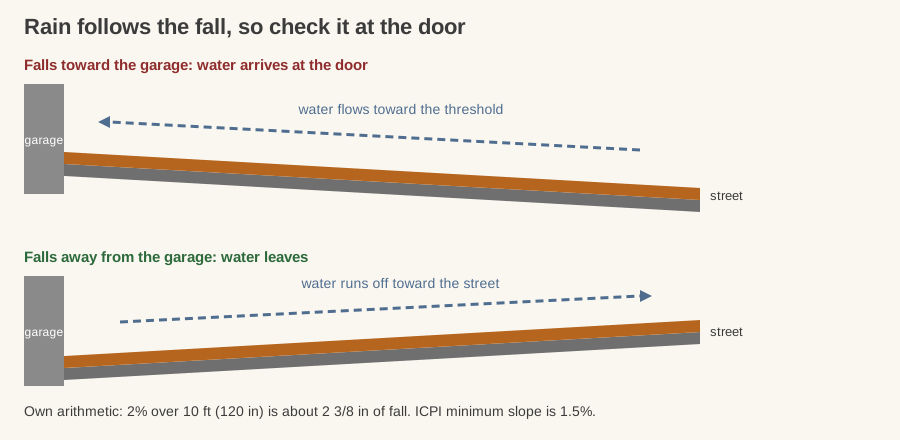
Do this during or just after rain, because the water shows you the answer for free.
- Watch where a puddle or a stream of water runs on the apron. If it runs toward the door, that is your answer.
- Dry day: lay a long straight board or a 4-foot level on the pavers, starting at the garage slab and pointing out toward the street. Lift one end until the bubble is level and measure the gap under the other.
- Do the arithmetic. ICPI Tech Spec 2 gives a minimum surface slope of 1.5%, and the building code wants impervious surfaces within 10 feet of the foundation to fall at least 2% away from the building, and grade away from the foundation by at least 6 inches within the first 10 feet (IRC R401.3, model code; adoption varies, so check with your local building department). My own arithmetic: 2% over 10 feet is about 2 3/8 inches of fall.
If the board shows the pavers falling toward the garage, or flat, the surface is the cause. If it shows a proper fall but water still reaches the door, the water is coming from somewhere else.
Stop the water arriving from uphill first
This is the cheapest fix, so check it before you lift a single paver. Landscaping Network's driveway drainage guide says a driveway should slope gently away from the house, and lists placement and slope, drains, swales and permeable surfaces as the options. Before any of those, look uphill.
- Does a downspout discharge onto the driveway? Re-route it. Our downspout drain under patio guide covers pipes that carry roof water away.
- Does the yard or the neighbor's lot shed water onto your drive? Then the apron has more water to handle than it was built for.
- Is a gutter overflowing at one corner, so a stream hits the same strip every storm?
Fix the source and watch the next rain. If the door stays dry, you are finished.
Lift and re-pitch the apron
A paver apron is the repair-friendly case: you can lift pavers, fix what is under them, and put the same ones back. Our paver driveway apron guide covers slope toward the street and base depth, and paver driveway slope covers fall and steep grades.
- Mark the area that falls the wrong way, and lift the pavers past it. Stack them in order.
- Look at the base. A dip right at the door usually means the base settled where the slab and the pavers meet.
- Rebuild the base in thin, compacted lifts so the surface falls away from the door at 2%, then screed 1 inch of loose bedding sand, lay the pavers, and re-sand the joints.
Our how to fix sunken pavers guide has the full sequence. One honest limit: if the street is higher than the garage floor, you cannot make the driveway fall away from the door with pavers alone. Then the plan is a drain, and the drain needs somewhere to send the water.
My one firm opinion: re-pitch before you buy a grate. A drain at the bottom of a slope that points at your garage is a bucket with a lid, and the grade is free.
A drain across the door is the backup, not the cure
Landscaping Network says a trench drain can be installed where the driveway meets the garage, running the entire width of the driveway, with a metal grate to keep debris out, and one of its examples is a driveway that slopes toward the house, fixed with a trench drain and permeable pavers. That is the right tool when you cannot re-grade.
Two cautions. A drain only works if it has an outlet that is lower than the drain, so the water has to leave through a pipe to daylight, a drywell or another approved discharge. I could not find an official installation standard in the pages I opened, so follow the drain maker's manual and check your local rules on where water may go. Second, a drain that clogs with leaves and grit stops draining, so plan to rake it out.
For smaller jobs, our paver drain guide covers drains in a paver surface.
When it is not a paver job
Stop and get someone to look if:
- Water is already getting into the garage slab seam or under the slab. An asphalt contractor's page notes that water entering the seam between the driveway and the garage floor softens the base and speeds up settling. It is a marketing page, but the mechanism is plausible.
- The slab itself falls toward the door and needs re-pouring.
- The fix needs a connection to a storm sewer or the street. Many places control this, so ask the municipality.
Fixes that waste a weekend
- Topping up the dip with sand or stone. A low spot filled without fixing the fall is still a low spot.
- A surface patch. The same contractor says a patch hides the dip for a few weeks and does not fix a weak base or water flow.
- A grate with nowhere to send the water. It just moves the puddle.
Fix the fall first, add the drain second
Driveway water into garage is a grade problem wearing a threshold costume. Find out which way the apron falls, stop water arriving from uphill, lift and re-pitch the pavers, and put a drain across the door only if the street is higher than your floor. After that, the door can finally stay dry without help.
FAQ
Why is driveway water going into my garage?
Usually because the apron falls toward the door, a low spot at the threshold holds water against it, or water arrives from uphill. Watch where the water runs during rain and measure the fall with a level.
How much slope should a paver driveway have at the garage?
ICPI's minimum surface slope for pavers is 1.5%, and the model building code wants impervious surfaces within 10 feet of the foundation to fall at least 2% away from the building. Check what your local building department has adopted.
Can I fix water coming into the garage without replacing the driveway?
Often yes. Pavers can be lifted, the base re-set to fall away from the door, and the same pavers laid back. A drain across the door is the option when you cannot re-grade.
Should I put a trench drain at the garage door?
Only after the fall and uphill water are sorted. Landscaping Network describes one running the width of the driveway at the garage, but it needs an outlet and regular cleaning.
Why does the driveway sink right at the garage?
Water getting into the seam between the pavement and the garage floor softens the base, and the apron takes heavy braking and turning loads. Rebuild the base, not just the surface.


