

Last Updated on October 20, 2026 by Umar Farooq
Hot tub pad pavers work as a base if the pavers are at least 2 3/8 inches (60 mm) thick, sit on a deep, compacted gravel base with a rigid edge restraint, and the finished pad is level and wider than the tub. A filled tub with people in it can exceed 5,000 lbs, according to Engineer Fix, so the base has to be built like a small driveway, not a garden path. If you are not sure you can build that, pour a concrete slab instead.
(A hot tub is the only patio feature that gets heavier the moment you enjoy it.)
Know what you are putting on the ground
Engineer Fix puts a full hot tub with occupants above 5,000 lbs. Do the arithmetic for your own: a 7 by 7 foot tub is 49 square feet, so 5,000 lbs works out to roughly 100 lbs on every square foot, standing still for years, with the heaviest part around the rim and the water. A paver patio for chairs sees a small fraction of that.
Most manufacturers list acceptable bases in the manual: concrete, a reinforced pad, sometimes pavers. Read it first. The Hydropool guide notes that a paver pad over bare topsoil can shift over time and leave the tub out of square, which is a warranty argument waiting to happen. If your manual does not list pavers, ask the dealer, in writing, before you build.
Pavers or a ready-made pad: try the cheaper one first
I would not start with pavers. Start by asking whether a ready-made spa pad or a simple concrete slab is allowed by the manufacturer, because those are quicker and the tub's weight is spread by the slab itself. Hydropool prices a paver pad at roughly $500 to $2,000 depending on block style, which is cheap for the job.
Pavers earn their place when:
- You want the pad to match an existing paver patio.
- The pad will need to be moved, repaired or have utilities reached later, because individual pavers lift out.
- You are willing to do the base work properly.
If any of those are not true, a slab is the safer call.
Build the pad base as if the tub is already full
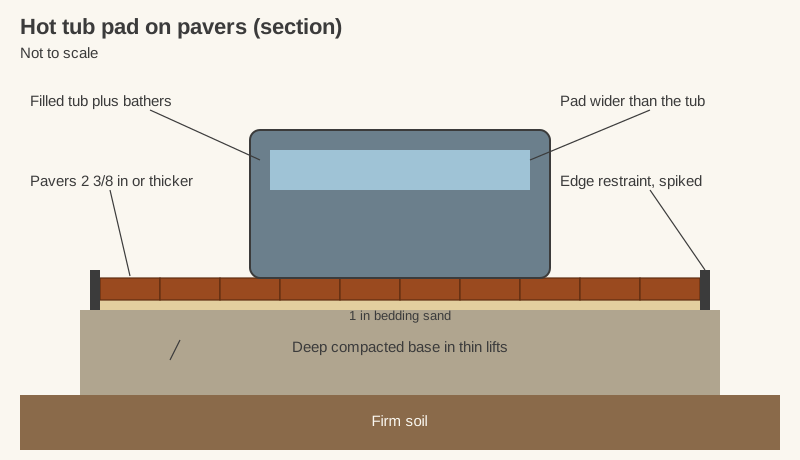
The pavers spread the load. The base carries it. For a hot tub the base is the whole point.
- Excavate deeper than a patio. Engineer Fix recommends 8 to 10 inches below finished grade. ICPI's spec calls for at least 4 inches of compacted base under a patio and 2 to 4 inches more on wet or weak soil (ICPI Tech Spec 2), so a tub pad on soft soil goes well beyond the minimum.
- Compact in lifts. ICPI's 4 to 6 inch lift assumes a 7,000 lbf plate, and smaller plates need thinner lifts. Engineer Fix keeps lifts to 4 inches or less. Rent a plate compactor, see plate compactor rental, and do the whole base in the rental window.
- Hit the density. CMHA's guide spec calls for 98 percent of standard Proctor density for pedestrian areas (ASTM D698). A tub is not a pedestrian area, so treat that as the minimum and ask a local engineer if the soil is soft.
- Sand bed. About 1 inch, screeded and left uncompacted. The sand is not a leveling layer, so fix the base if it has a dip.
- Check flat. CMHA allows 3/8 inch over a 10 foot straightedge on the base surface. A tub wants closer, so check with a long level in several directions.
Our paver base guide covers materials and how deep to go.
Choose a thick paver and lock the edges
CMHA's Tech Spec 10 recommends 2 3/8 inches (60 mm) for pedestrian paving and 3 1/8 inches (80 mm) where vehicles drive. A tub is a point load, not a moving one, but if you want margin, the 80 mm unit is a cheap upgrade. See paver thickness for how thickness and shape interact.
Edge restraint is not optional. The pad is a boxed-in field, and a heavy load pushes sideways as well as down. Spike a restraint into the base all the way around, as in paver edging, and extend the base past the spikes by the base thickness, up to 10 inches (CMHA).
Make the pad wider than the tub so the skirt, steps and a service path are on pavers and the tub is not sitting at the edge.
Plan the water and the wires first
Hot tubs drain, splash and overflow. Slope the ground around the pad away from the tub and house, and see patio drainage for the details. The pad itself needs to be level for the tub. That means water leaves the surrounding surface, not the pad.
Electric supply to a tub is a job for a licensed electrician, with the right GFCI protection and local permits. Lay conduit under the base before the pavers go in, and call 811 before you dig.
Level, rigid and wider than the tub
A good hot tub pad on pavers is a thick paver on thin sand over a deep, well-compacted base, locked by a spiked edge. Check the manual, start with the slab question, rent the compactor for a full day, and compact every lift. If the base is wrong, the tub will tell you by tilting.
FAQ
Can you put a hot tub on pavers?
Yes, if the pavers sit on a deep, compacted base with edge restraint and the pad is level. Check your manufacturer's manual first, because some warranties name the acceptable bases.
How thick should pavers be for a hot tub pad?
At least 2 3/8 inches (60 mm), the minimum for pedestrian paving per CMHA. A thicker 80 mm unit gives more margin for a point load.
How deep should the base be for a hot tub on pavers?
Engineer Fix recommends excavating 8 to 10 inches. ICPI's patio spec gives at least 4 inches of compacted base, with 2 to 4 inches more on weak or wet soil, so plan deeper than a normal patio.
How much does a filled hot tub weigh?
Engineer Fix says a full tub with occupants can exceed 5,000 lbs. Your tub's manual lists its own filled weight.
Is a concrete slab better than pavers for a hot tub?
A slab is quicker and spreads the weight on its own, so it is the safer choice if you doubt your base. Pavers win when you want the pad to match a paver patio or need to lift sections later.


