


Last Updated on October 20, 2026 by Umar Farooq
How to use a plate compactor on a paver job: check the machine and the ground first, start it at a gentle throttle, then walk it in straight, overlapping passes over a base that is damp and spread in thin layers. Do the base in lifts, not in one thick pile, and tie the lift thickness to the weight of your plate. Then compact again after the pavers are laid and once more after the joint sand. The machine does the work. Your job is to steer, keep the base damp and not hurry.
The first-time mistake is not how you hold the handle. It is the thickness of what you are compacting.
Check the plate and the ground before you pull the cord
Riequip's guide to using a plate compactor starts with the boring part, and it is right to: look the machine over for damage and loose parts, check the fuel and engine oil, clean or replace a blocked air filter, and make sure the throttle and emergency stop work. OMC's tips add protection: hearing and eye protection, gloves, a dust mask and steel-capped boots.
Then check the ground. ICPI's Tech Spec 2 says base aggregate should be at its optimum moisture when compacted, and describes the hand test for soil: moist, with no visible water, so it sticks together as a ball when squeezed and breaks into a few pieces when dropped from 6 to 12 inches. OMC puts it in plain words: too wet and the stone turns to slurry, too dry and it will not bind. Never compact frozen base material, or put base over frozen subgrade (ICPI).
Gas engines also put out carbon monoxide. NIOSH's joint alert says small gasoline engines can cause serious illness and death "even in apparently well ventilated spaces," so keep it outdoors. Running a plate in a closed garage to "warm it up" is out.
Start gently, then let the plate pull itself along

Set the plate on the area you are about to compact, start the engine according to the manual, and let it warm up, especially in the cold (Riequip). OMC warns against starting at full throttle, because the plate bounces hard at first, which is less safe and gives a poorer result. Bring the throttle up, hold the handle with both hands, and let it move. The plate walks itself forward. You steer it.
Riequip's advice for the walk is to use steady, straight, overlapping passes, avoid sudden stops and sharp changes in direction, and let the vibration do most of the work rather than pushing or pulling. A reversible plate travels both ways, which saves wrestling it around in a tight spot. (If you are pushing hard enough to sweat, the machine is not the one making a mistake.)
Overlapping passes: how far to move over each time
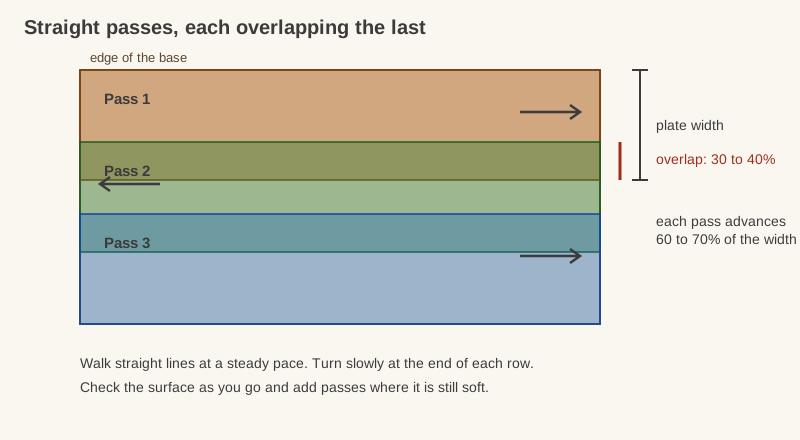
OMC suggests overlapping each pass by 30 to 40% so no strip is missed. That means each pass advances 60 to 70% of the plate's width. Walk straight lines at a steady pace, turn slowly at the end of each row, and look at the surface behind you.
There is no single pass count that suits every job. Riequip says to inspect as you go and add passes where the surface is still soft or under-compacted. ICPI's numbers apply once the pavers are down (see below).
How to use a plate compactor on the base: lifts, not piles
Here is my one firm opinion. A thick layer of gravel compacted once from the top is not compacted. It just has a hard crust over loose stone, and that settles under the pavers later.
ICPI says to spread and compact the base in 4 to 6 inch lifts "using 7,000 lbf reversible plate compactors," and that "thinner lifts will be required for compactors in the 5,000 lbf range." Read that twice, because it is the most misquoted number in paving. The 4 to 6 inches belongs to a big plate, and a small rental plate means a thinner layer. So a 4 inch base is built as many lifts as your plate can do properly, each compacted before the next goes on.
For a patio on well-drained soil, ICPI calls for at least 4 inches of compacted base. The target is at least 98% of standard Proctor density (ASTM D698), which no homeowner can measure without a gauge. What you can check is whether the surface stops changing. For field checks, see how to test soil compaction.
After the pavers are down: pavers, sand, then the joints
ICPI says the plate for laid pavers should exert a minimum of 5,000 lbf of centrifugal force and run at 75 to 90 hertz, with at least two passes to seat the pavers in the bedding sand and push sand into the joints. Then sweep dry joint sand into the joints and compact again until they are full, which may take two or three passes. If the sand is wet, dry it first.
Compaction should stay within 6 feet of an unrestrained edge or the laying face. Every paver within 6 feet of the laying face should have its joints filled and be compacted by the end of the day, and ICPI says to cover the uncompacted edge if rain threatens. The full routine for finished pavers is in compacting pavers.
Rent the plate, and match its size to the lift
The cheaper option comes first: you do not need to own one. Rent a plate compactor for the base and the pavers inside one rental period. Before you sign, ask the plate's weight and force, then set your lifts to match. If you are still choosing a machine, see plate compactor for pavers.
Thin lifts, damp stone, overlapping passes
That is the whole technique. Check the machine, start gently, keep the stone damp, walk straight and overlap each pass by a third, and match the lift to the plate. (Nobody has ever regretted a thinner lift.) The stone will tell you when it is done, and it will not be shy about it.
FAQ
How many passes should you make with a plate compactor?
There is no one number. On the base, inspect as you go and keep adding passes until soft spots stop moving. On laid pavers, ICPI says at least two passes to seat the pavers, then two or three more after the joint sand goes in.
How thick can a lift be with a plate compactor?
ICPI says 4 to 6 inches with a 7,000 lbf reversible plate, and thinner lifts for compactors around 5,000 lbf. Check the force rating of your rental plate.
Should the gravel be wet when you compact it?
It should be damp. ICPI wants the aggregate at its optimum moisture, which feels like a ball that holds together and breaks into pieces when dropped. Too wet turns to slurry and too dry will not bind.
Can you use a plate compactor on pavers without damaging them?
Yes, if the pavers are laid on a screeded bed and the plate is the right size. ICPI specifies a plate with at least 5,000 lbf of force at 75 to 90 hertz for seating pavers. Avoiding chipped pavers is covered in compacting pavers.


