

Last Updated on September 27, 2026 by Umar Farooq
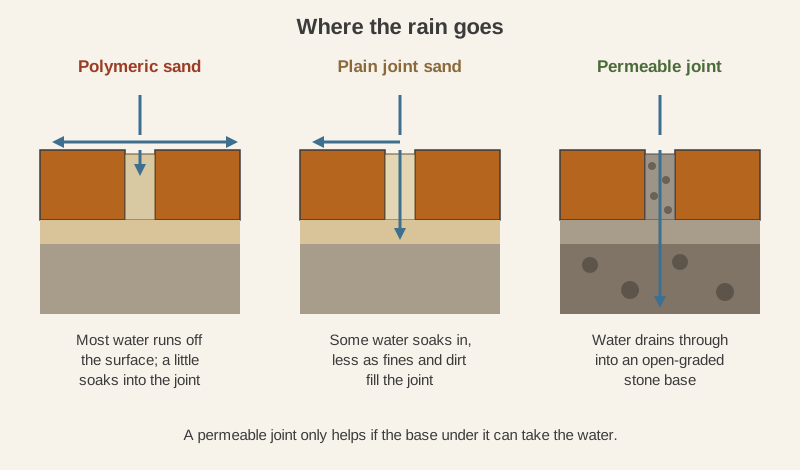
Is polymeric sand permeable? Not in any way that helps drainage. Once cured, polymeric sand is designed to shed water off the joint rather than let it soak through, so rain runs across the patio to its low edge. A little moisture does wet the joint, which is why it softens after rain, but the patio relies on its surface slope to drain. If you need water to pass through the joints, as on a permeable paver system or where local rules limit hard surfaces, use a permeable jointing product such as WetLok or Techniseal STORM, or open-graded stone chips over an open-graded base.
The internet has a habit of turning this into a number. I kept running into a claim that polymeric sand passes "about 3 percent" of rainfall, repeated from site to site. I couldn't find a test, a standard or a manufacturer behind it, so I'm not going to repeat it as fact. What the manufacturers do say is more useful.
What the data sheets say about water

Manufacturers describe polymeric sand as water-resistant, not water-permeable:
- Techniseal says its standard sands start "repelling water a few minutes after initial wetting", which is why you water them in 200 sq ft sections.
- Alliance Gator describes Maxx G2 as formulated to repel water with minimal absorption. It also says the joints soften when wet and harden as they dry, which is how they flex and self-heal.
- The University of Florida's IFAS extension puts it plainly in a stormwater article: polymeric sand "is not porous," so water can't soak through it. It recommends permeable paver sand where cutting runoff is the goal.
So "semi-permeable," the word some blogs use, is generous. A cured joint gets damp. It doesn't drain the patio.
Does polymeric sand allow drainage under the pavers?
The water that does reach the joint still has to leave, and that's where polymeric sand causes real problems. Every data sheet I read says the bedding layer must drain. Techniseal warns that bedding or screenings that don't drain "will trap moisture." Alliance says its sand can't go over a stone-dust bed at all, because stone dust holds water and the joint fails.
The practical result: polymeric sand works well on a correctly sloped patio with a draining sand bed. It struggles anywhere water collects, such as flat spots, low corners against a wall, or overlays on a slab without drainage holes. There the joints stay soft, grow moss, and get blamed for a drainage problem they didn't cause.
Drainage is the slope's job, not the joint's
Here's my position. Don't choose a joint material to fix drainage. On a standard patio, water is meant to run off the surface, and the slope does that job.
ICPI's Tech Spec 2 sets a minimum surface slope of 1.5 percent. Alliance's Gator data sheets ask for 2 percent, and at least 1/8 inch per foot away from pool edges and structures. Under the pavers sits a compacted dense-graded base, compacted to at least 98 percent standard Proctor under CMHA's guide spec. That layer is designed to carry load, not to absorb rain. Swap in a permeable joint filler on that build and the water that gets through simply meets a dense base and slows to a crawl.
If water is pooling on your patio, the answer is regrading or a drain, covered in our guide to patio drainage. A different sand won't fix it.
Permeable jointing sands: WetLok, STORM and stone chips
When you do want water through the joints, these are the main options:
| Option | What it is | Joint range | Notes |
|---|---|---|---|
| WetLok (SRW Products) | pre-mixed, air-curing permeable jointing sand | 1/8–5 in, 1 1/2 in deep | installs wet, even in rain; above 37°F; 36 lb tubs |
| Techniseal STORM | permeable jointing compound | 1/8–2 in, 1 in deep | installs on wet pavers; needs a porous bed; cars after 5–7 days |
| Alliance Gator Nitro | premixed resin-aggregate joint | 3/16–2 in | lets water through but clogs with dirt; not for driveways |
| Open-graded stone chips | small clean crushed stone (the permeable-paver standard) | wide joints of permeable pavers | cheapest; needs topping up |
SRW's WetLok product page rates it for concrete pavers, natural stone and wet-cast products. It comes in five colors (Tan, Granite, Black, Platinum and Beach), and one 36 lb tub covers about 45 to 60 sq ft of standard paver joints. You sweep it into joints that are already wet and keep them wet until the joints are full.
Two cautions apply to all of them. Permeable joints clog. Alliance says its Nitro compound "will clog up from dirt and debris," and Techniseal notes that STORM's permeability can change as contaminants enter the joint. Both recommend light pressure washing to restore it. And a permeable joint only drains as well as the layers beneath it. True permeable pavers sit on open-graded stone (CMHA's permeable spec uses a 2-inch No. 8 stone bedding over a 4-inch No. 57 base), not on sand over dense gravel. That full system is explained in permeable concrete pavers.
Can you make polymeric sand permeable?
No. The polymers that make the joint hold together are the same ones that shed water. Loosening the binder would bring back washout and weeds. If you have polymeric joints and need permeability, the only route is to scrape the joints out to full depth and refill with a permeable product, on a base that can take the water. For how the Techniseal permeable and standard grades differ, see our Techniseal polymeric sand guide.
Slope for runoff, permeable joints only on a permeable build
So, is polymeric sand permeable? No, and on a normal patio it doesn't need to be. It stabilizes the joints while the surface slope carries rain away. Choose a permeable joint filler only when the base under it is built to take water, or you've just moved the puddle down an inch. Get the slope right first. The sand is along for the ride.
FAQ
Does water drain through polymeric sand?
Very little. Cured polymeric sand gets damp and softens in rain, but it's designed to shed water, so a standard patio drains by surface slope, not through the joints.
Is polymeric sand bad for drainage?
Not on a correctly sloped patio with a draining sand bed. It becomes a problem where water pools, over stone-dust beds, or over concrete without drainage holes. There the joints stay wet, soften and grow moss.
What is permeable jointing sand?
It's a joint filler that stabilizes pavers while letting water pass down through the joint. Examples include SRW's WetLok, Techniseal STORM and plain open-graded stone chips on permeable paver systems. It needs an open-graded base to be worth using.
Can you use polymeric sand on permeable pavers?
No. Permeable pavers work by draining through their wide joints into an open-graded stone base. Polymeric sand would seal those joints, and the fine sand can wash into the open stone below. Use the stone chips or permeable product the paver maker specifies.


