

Last Updated on October 20, 2026 by Umar Farooq
Path light spacing for a residential walkway usually lands between 6 and 10 feet apart, staggered from one side of the path to the other, with the lights pulled closer (about 4 to 5 feet) at steps, curves and changes of grade. Brighter fixtures can sit farther apart, dim solar stakes need to sit closer, and the only way to be sure is to lay the fixtures out on the surface at dusk before anything gets buried. We have a separate page on pavers separating if you need the specifics.
I read four path lighting guides to see how far apart they put lights, and they do not agree. That is not as annoying as it sounds, because the disagreement tells you what to adjust. If you are lighting a paver walkway in particular, there is a second question hiding behind the first: where, exactly, do the stakes go?
Why the guides give four different answers
Here is what each page I opened says about spacing.
| Source | Spacing it recommends | What it ties the number to |
|---|---|---|
| Portfolio Lighting | About 6 to 10 feet | Fixture brightness, beam spread and the look you want |
| Yardtopia | 6 to 8 feet; 4 to 5 feet at steps, curves and grade changes; 8 to 10 feet on straight, flat runs | How far ahead the eye can see |
| HomElectrical | 5 to 15 feet overall; 5 to 6 feet for security, 6 to 8 feet in a garden, 8 to 15 feet for general landscaping | What the light is for |
| This Old House | 10 to 15 feet, "creating gentle pools of light" | Pools of light rather than continuous light |
Three of the four overlap somewhere around 6 to 10 feet, which is why I would start there. The 10 to 15 foot figure belongs to the "pools of light" school, where the dark gaps between fixtures are part of the design. The 5 to 6 foot figure is for people who want a path they can read like a runway.
The spacing is not really a rule about feet. It is a rule about overlap. Yardtopia says a 15 to 50 lumen solar fixture lights a circle of walkway roughly 3 to 4 feet across, while low-voltage fixtures put out 50 to 200 lumens. A dim stake and a bright one cannot sit the same distance apart and do the same job.
Stagger the lights, because matched pairs look like an airport
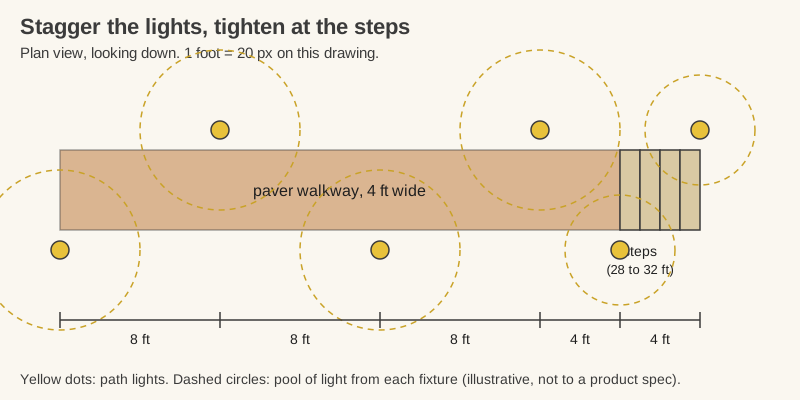
Two of the sources make the same point in almost the same words. Portfolio says to alternate sides and avoid placing lights directly across from each other, and Yardtopia says to stagger rather than line up. Matched pairs produce a runway effect that reads as commercial, and they use twice the fixtures for the same lit distance.
A staggered layout also spreads the light in both directions across the width of the walkway, so the far edge is not left in shadow. On a standard 3 or 4 foot walkway (see paver walkway width), a light on one side still washes the whole path.
A simple way to lay it out:
- Put the first light near the entrance, where the path leaves the driveway or the door.
- Step off 8 feet (the middle of the 6 to 10 range) and put the second light on the opposite side.
- Keep alternating at the same interval along the straight sections.
- Add one more light at every curve, step and junction (see the next section).
Tighten the spacing at steps, curves and gates
Straight, flat sections forgive a wide gap. Steps do not. Yardtopia puts the spacing at 4 to 5 feet where the ground changes, and I agree with the reasoning, because the one place you cannot afford to guess is the edge of a riser. Portfolio's advice is the same in different words: give extra attention to curves, turns and intersections, because that is where the eye and the feet need guidance.
For the steps themselves, a light on the walkway side of the riser is a start, but a lower fixture set into the step wall does a better job. The paver steps ideas article shows where those walls sit.
Two cases where I would go closer than the range:
- Dark surfaces. Yardtopia says that on dark mulch or dark stone you should consider closer spacing or a higher-lumen fixture, because light-colored surfaces reflect noticeably more of the light. It was writing about gravel and decomposed granite paths, not pavers, so treat charcoal pavers as a case for the same principle rather than a measured rule.
- Solar fixtures. HomElectrical notes that solar path lights emit a softer glow and are best placed closer together.
Turn path light spacing into a shopping count
This is arithmetic, not a spec: Portfolio's rule is to divide the length of the path by 6 to 10 feet, and then add one for the start.
| Path length | At 10 ft spacing | At 8 ft spacing | At 6 ft spacing |
|---|---|---|---|
| 20 ft | 3 | 3 | 4 |
| 32 ft | 4 | 5 | 6 |
| 50 ft | 6 | 7 | 9 |
| 80 ft | 9 | 11 | 14 |
(Those counts are my own arithmetic from path length divided by spacing, rounded down, plus the first light. Add the extras for steps and curves on top.)
Check the wattage before you commit, because lights add up. A short path of five or six LED fixtures is a small load. For sizing the transformer, cable runs and voltage drop, the paver patio lighting guide covers how to plan it, and that is also where it explains the better moment to run cable: before the pavers go down.
Keep the stakes out of the pavers
This is the part the general guides skip, and it is the reason a paver walkway needs its own thinking.
A path light on a stake wants soft ground. A paver walkway is the opposite: compacted stone, a loose inch of bedding sand and tight joints. Driving a stake through a joint means pushing it into a base that was compacted to be hard, and a hole in the joint sand is the first place for water and weeds to find. My reasoning here, not a quoted rule: put the fixtures in the strip of soil, mulch or lawn beside the walkway, just off the edge restraint, and let the light reach across the pavers.
That works with the way the sources describe the fixtures, since path lights typically stand a little over a foot tall. This Old House and HomElectrical both recommend a mounting height of about 14 inches, and HomElectrical says 12 to 18 inch fixtures make a smaller pool of light, while 18 to 26 inch ones suit bigger areas.
If the beds beside the path are narrow, move the fixtures a few inches back from the edge rather than leaning them on the paver border. You are lighting the path, not decorating the edging.
For lights that sit inside the pavers, cable has to be planned in the base, which is a different job from staking. The paver walkway installation guide covers the base, and a spare conduit under the path costs almost nothing while the base is open.
Check the layout at dusk before you bury anything
The sources all end up in the same place: test it. Portfolio's test is that if the path is easy to follow without glare, the placement is right.
- Lay the fixtures out on the surface (or stick them in the ground without trenching) at the planned spacing.
- Do it after dark. A daylight guess says nothing about glare or dark gaps.
- Walk it, then walk it backwards. The view from the street and the view from the door are different.
- Cover or swap any fixture that glares into your eyes at walking height.
- Move before you bury. Cable depth recommendations differ between sources (This Old House says about 3 inches, Yardtopia says at least 6), so follow the manual for your product, and call 811 before digging a trench of any length.
Fewer lights, set farther apart, than your instinct says
The usual path lighting mistake is too many fixtures too close together. Portfolio says the most common error is adding more lights when the real issue is poor placement, not too little light. I agree, and the mechanism is easy to see: the eye adapts to the nearest bright point, so a dense line of fixtures makes everything between them look darker.
Start with the 6 to 10 foot range, stagger the lights, tighten at the steps and bend, and add one fixture only if the dusk test shows a gap. If you are still staring at a pallet of lights and a tape measure, remember that the cheapest light on any walkway is the one you did not buy.
FAQ
How far apart should path lights be?
Most guides put path lights about 6 to 10 feet apart, staggered on alternating sides of the walkway. Sources range from 5 to 15 feet depending on brightness and purpose, so treat the range as a starting point and adjust at dusk.
How many path lights do I need?
Divide the length of the path by the spacing and add one for the first light. A 32-foot walkway at 8-foot spacing needs about five lights, plus extras for steps and curves.
How far apart should solar path lights be?
Closer than low-voltage fixtures. HomElectrical says solar lights emit a softer glow and should be placed closer together, and Yardtopia describes a typical solar stake as lighting a circle roughly 3 to 4 feet across.
Should path lights be on both sides of a walkway?
Not directly opposite each other. Alternate sides in a staggered pattern, which lights the whole width of the path with fewer fixtures and avoids a runway look.
How tall should path lights be?
About 14 inches is the figure given by This Old House and HomElectrical. HomElectrical adds that 12 to 18 inch fixtures make a smaller pool of light and 18 to 26 inch fixtures suit larger areas.
How do I light a paver walkway without drilling into the pavers?
Set stake-mounted fixtures in the soil, mulch or lawn beside the walkway, and let the light reach across the pavers. If you want lights inside the pavers, plan the cable and the pocket in the base before laying.


