

Last Updated on October 20, 2026 by Umar Farooq
Pavers separating almost always means something is letting the field spread: a weak or missing edge, a base that is moving, or a long straight joint line that gives the pavers a track to slide on. The fix is to find which one, repair that, and only then refill the joints. Topping up the sand first is a bit like mopping under a leaking tap.
All three sources I opened for this are short, and the fix steps overlap, so the useful part is the order to check things.
First, check whether the gaps are actually too wide
Pavers are meant to have joints. Hunker's guide recommends a gap of about 3 mm, roughly 1/8 inch, for most pavers, because the sand-filled joint lets the units move slightly with expansion and contraction. Brick can go up to about 1/2 inch for looks, and large concrete units are happiest at 1/8. Our how much space between pavers guide has the range by product.
So a hairline gap is nothing. Worry when:
- joints are visibly wider than at install, especially in one area,
- the sand keeps dropping out of the same place, or
- a paver rocks when you step on it.
Where the gaps open tells you why
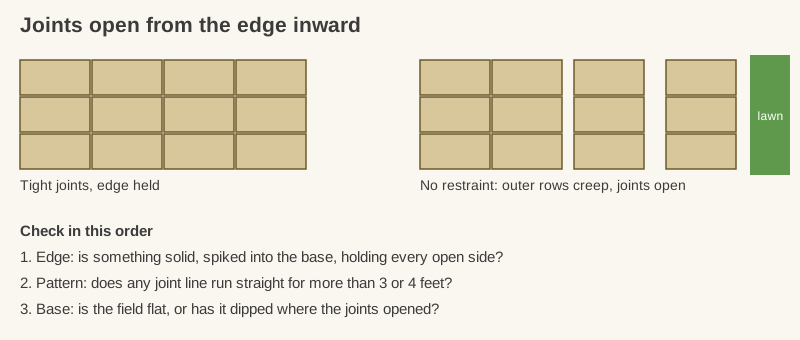
Look at the pattern before you pick up a tool.
Gaps at an open edge, widening toward the lawn. The edge restraint has failed or never existed. HouseDigest says that without a secure edge "the entire layout may begin to pull apart" as the stones shift outward. This is the same failure we walk through in how to keep pavers from moving, and the repair is a restraint spiked into the base. The same piece suggests digging the edge base 6 to 8 inches beyond the planned perimeter. CMHA's guide spec sets the distance from the base edge to the restraint spikes at the base thickness, up to 10 inches (CMHA PAV-GSP-011-21), so on a thick base you may need more than 6 to 8.
Long straight joint lines across the middle. The Agrio guide says the installer likely ignored the manufacturer's layout, and that no continuous joint line should run longer than three or four feet. Without staggering, units slide apart along the line. Check your layout against the maker's pattern sheet.
Gaps plus a dip, or standing water. The base has moved. HouseDigest ties settling and sinking to poor compaction, and says pooling water washes the sand out of joints. If the patio is flat, a joint refill is a fair temporary fix. If it dips or collects water, lift, rebuild the base and relay.
Weeds are a symptom you can't ignore
Once joints open, seeds land and roots pry the pavers further apart. Pull what you can and see how to remove weeds from pavers, then refill. Clean the joint of old sand and weeds first, so new sand has something to grip.
Fix 1: refill the joints, if the patio is flat
Check the surface with a long level or straightedge. The Agrio guide says that if it is still flat you can usually stabilize it without relaying. Clean out the joints, let them dry, sweep in polymeric sand and mist it to activate the binder.
Check the product's limits first. Alliance Gator's SuperSand G2 data sheet allows joints from 1/8 to 2 inches wide and wants a minimum joint depth of 1 1/2 inches, with the finished sand at least 1/8 inch below the paver top. Another maker's numbers will differ, and the bag in your hand wins. It also needs dry weather: Alliance Gator says it is rain safe 15 minutes after activation, and Techniseal's HP NextGel says 60 minutes. Our how to apply polymeric sand walks the steps.
Avoid play sand. Agrio notes it has no binder and washes out in heavy rain.
Fix 2: lift, rebuild and relay
If the joints reopen within a season, they were never the problem. HouseDigest's three causes (a poorly compacted base, poor drainage and a missing edge) all live below the pavers. Lift the affected pavers in numbered rows so you can put them back, rebuild the base in thin lifts, set the edge, screed one inch of sand and relay with a staggered pattern. If part of a run needs replacing, read paver patio repair.
Don't cheat with extra sand or wide joints
Two shortcuts show up in forums. One is stuffing more sand into a large gap. Sand does not hold pavers together; the edge and the base do. The other is relaying with wider joints to stretch what is left. Hunker's rule is "less is more", because wider joints allow more movement over time.
Close the gap by fixing what let it open
Check the edge, then the joint lines, then the base. Refill only when the field is flat and tight, and rebuild when it is not. If you want a quick test, press a boot into the loosest edge row: if it rolls toward the lawn, the restraint is your answer.
FAQ
Why are my pavers separating?
Usually because the edge restraint failed, the layout has long straight joints or the base has settled or washed out. Check the edge first.
How do I close gaps between pavers?
If the patio is flat, clean the joints and refill with polymeric sand, then activate it with water. If the pavers rock, dip or keep opening, lift and rebuild the base and edge.
What is a normal gap between pavers?
About 1/8 inch (3 mm) for most concrete pavers, per Hunker. Brick can go to about 1/2 inch.
Can I use regular sand to fill wide gaps?
You can, but it washes out in heavy rain. Polymeric sand holds better and has its own width limits, so read the data sheet.
Do pavers need edge restraint?
Yes. Without a solid restraint, the outer rows spread, the joints open and the sand washes out.


