


Last Updated on October 20, 2026 by Umar Farooq
A small backyard paver patio works when you fix the footprint first, then choose one paver size, one pattern and one or two built-in features, and build the base exactly as you would for a big patio. Small spaces forgive almost nothing visually, and they forgive nothing structurally either. A 10 by 10 foot patio has the same four layers under it as a 30 by 30 one, and it has far less room to hide a mistake in.
I read through the top small-patio guides before writing this, and almost all of them are a gallery of pretty photos with the base left out. This one covers the layout decisions that make a compact patio feel bigger, and the build details that keep it flat.
Start with how many chairs, not how many square feet
Most small patios fail because the footprint was chosen from what the yard had left over. Start from the furniture instead.
Decide what the patio must hold on a normal Saturday: a bistro table and two chairs, a four-seat dining set, or a lounge pair and a fire bowl. Lay the real furniture on the grass, or mark it with a hose and flour, and sit in it. Pull the chair out as if you were getting up. If the chair leg drops off the edge of your marked outline, the patio is too small for that set, and no paver pattern will fix it.
Two sizing checks help:
- Chairs need to pull out onto pavers, not lawn. Chair legs catching on the edge of a paver surface is the usual complaint with undersized patios.
- Leave a path to the door. A patio that blocks the way in and out of the house is just a very expensive obstacle.
(If you do the furniture test and the numbers look tight, a round table instead of a rectangular one saves more room than an extra row of pavers.)
If you are still weighing patio sizes against how many pavers you will need, our guide on how many pavers you need has the arithmetic.
Pick one paver and keep the pattern calm
On a small patio, every cut and every color change is visible from every chair. The cheapest way to make a compact space look deliberate is to restrain it.
Cambridge Pavingstones' small-patio design tips land in the same place as most guides I read: light or neutral colors, larger units and fewer pattern changes make a compact patio look more open. I agree with the principle, with one caution about large formats that I get to below.
- Color: light and mid-tone pavers read as more spacious than a dark field, and they show fewer shadows from nearby fences.
- Pattern: a running bond or a simple stack keeps the eye moving in one direction. Busy patterns suit big patios, where there is room to see them.
- Border: a single contrasting border row frames a small space nicely. Two borders and a medallion turn it into a rug.
- Size: one large format cuts the number of joints, but on a tiny patio each cut becomes a bigger share of the surface. Check how the dimensions divide into your footprint before ordering. A patio 8 feet 2 inches wide in 24 inch pavers leaves a 2 inch sliver on one side, which is the cut you are trying to avoid.
Build the base like the patio is twice the size

The pavers are the finish; the base is the patio. Small patios tempt people into skipping base depth because the digging looks like a lot of effort for a few square yards. The standard does not scale down.
The numbers that matter, from the Interlocking Concrete Pavement Institute's Tech Spec 2:
- At least 4 inches of compacted aggregate base under a patio on well-drained soil.
- Add 2 to 4 inches more in cold climates or on wet or weak soil.
- A nominal 1 inch of bedding sand, screeded and left uncompacted.
For a small patio you are not renting a plate compactor to buy it; rent one for a day, and plan the job so base compaction and the final pass over the pavers both fit in the rental. If you want the depth worked out for your exact footprint, use how much paver base you need.
An edge restraint matters even more on a small patio, because there are fewer pavers to hold each other in place. Every open edge gets one (see paver edging). Not the lawn, not the mulch.
Slope the patio away from the house, even if it is tiny
Water does not care how small your patio is. Next to the house, the 2021 International Residential Code asks for impervious surfaces within 10 feet of the foundation to slope at least 2 percent away from the building (R401.3). That works out to about 1/4 inch per foot. Check with your local building department, since adoption varies.
On a small patio the slope is easy to overlook because the surface looks flat. Set a string line from the house outward and drop it by that 1/4 inch per foot, then screed to the line. The rest of the drainage story is in patio drainage.
Let the edges do double duty
A small patio gains more from what is around it than from extra pavers. A few ideas that cost less than enlarging the field:
- A seat wall. A low wall doubles as seating and as a boundary, which saves floor space that chairs would take. See our guide to seat walls for height and base details.
- Planting beds in place of lawn strips. A narrow bed at the edge softens the boundary and keeps the patio from feeling like a pad. Beds need to sit lower than the paver edge so soil does not wash onto the surface.
- Vertical elements. Vertical structure such as a trellis, a screen or a pergola adds a sense of enclosure. If you plan a pergola later, plan post positions before laying (see paver patio with pergola).
- A courtyard feel. Enclosed small spaces benefit from the ideas in courtyard pavers.
One feature, not three
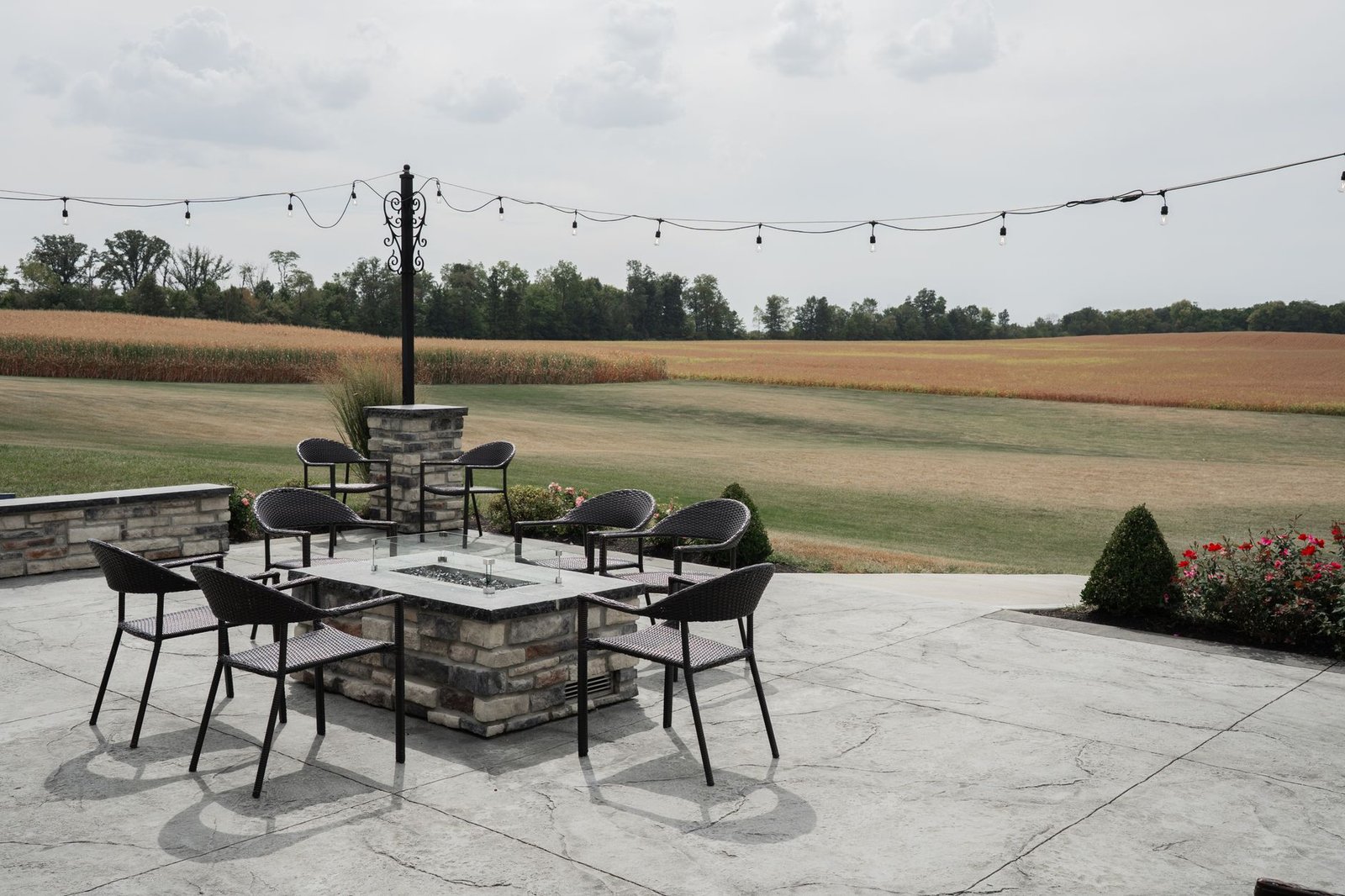
The urge in a small patio is to add a fire pit, a grill station and a pergola at once. Pick the one that matches how you actually use the space.
A fire feature is the common first choice, and it is also the one most limited by clearance. Check what your fire-pit manufacturer says about distance to seating and structures, and look at our notes on fire pit blocks before sizing the patio around one.
If you mostly eat outside, a table with room to pull chairs out beats a fire pit nobody can walk around. If you mostly sit, a pair of chairs and a small side table can be tidier than a full dining set. The honest limit of a compact patio is that it does one thing well.
Two cheaper starts for a very small yard
You do not have to pave the whole thing in one go. Two smaller approaches:
- A patio with a built-in expansion plan. Lay a generous base, but pave only the first section. Extending later is simple if the edge restraint sits on the base and the base extends past it.
- A mixed surface. Pavers where the furniture sits, with gravel or stepping stones around them. It costs less per square foot and drains easily.
For the second approach, the edges of the paved area still need a restraint, because loose gravel pushes on them.
Build small, but build it level
The last decision is the least glamorous. A small backyard paver patio succeeds on the same three things as a large one: a compacted base at the right depth, a screeded 1 inch sand bed, and a restrained edge. The footprint is the part you can adjust later. The base is not.
Mark the furniture, pick one paver, dig to the proper depth, and then spend the rest of the afternoon deciding who gets the good chair. (Pro tip: it is not the person who dug.)
FAQ
What size is a good small backyard paver patio?
Size it from the furniture, not from a number. Mark the table and chairs on the lawn, including the space to pull chairs back, and build the patio to the outline of that layout. A compact patio that holds one table comfortably beats a larger one that holds three pieces badly.
What pavers look best on a small patio?
Light or mid-tone pavers in a simple pattern such as running bond tend to look the most open. Keep to one paver type and, at most, one contrasting border row so the surface does not feel busy.
Do small paver patios need the same base as large ones?
Yes. ICPI's Tech Spec 2 asks for at least 4 inches of compacted base under a patio on well-drained soil, plus 1 inch of bedding sand. Wet, weak or freezing ground adds 2 to 4 inches. A small footprint changes the area, not the structure needed to carry it.
Can I build a small paver patio myself?
Yes, and a small one is a good first project because the digging, base and laying are all manageable in a weekend or two. Rent the plate compactor rather than buying it, and check utility lines before digging.
How do I make a small patio feel bigger?
Use light colors, a calm pattern, a border that frames the space, and edges that blend into planting rather than a hard line. A seat wall or a narrow planting bed gives the eye something to travel along and the patio more depth.


