


Last Updated on October 20, 2026 by Umar Farooq
Ants between pavers are almost always a nest, not a visit. The small piles of sand beside your joints are the spoil from tunnels running down into the bedding layer, and spraying the ants you can see will not touch the colony. The fix has three parts: put out slow-acting bait so workers carry it home, refill the joints with a hardening sand so there is nothing left to dig, and, if the patio is not built yet, choose base layers ants do not like.
It is a very humbling thing to spend a weekend laying a patio and then find that a creature the size of a grain of rice has already moved into it. (They did not pay for the permit either.)
Read the signs before you treat anything
The usual culprits are pavement ants. Pestideas describes them as black, about 1/8 inch long, with a telltale sign: small piles of sand or soil beside paver joints. That is excavated material, and it means a nest is somewhere underneath.

Pavers give ants cover and a protected spot, and the layer under them is soft, loose and easy to move. Look for these in the next few days:
- fresh piles of sand along the same joint after you sweep them away
- a steady trail of workers going in and out of one gap
- a paver that rocks or has dropped slightly, because ants removing material leaves voids behind
The last one matters. It is covered in a later section, and it is why this is a structural problem and not only a nuisance.
Bait the colony, because spraying only moves them
My strong opinion, and the cheapest one: use bait first, and spray last. A contact spray kills the workers on the surface and leaves the queen and the nest below it untouched. Pestideas recommends bait over spray for this reason: workers eat a sweet bait and carry it back to the nest, which is how it reaches the queen. Its recipe is borax mixed with sugar, sprinkled into the joints.
Other guides use commercial slow-acting gel or granular baits to the same end. Whichever you choose, three habits make it work:
- Put bait where the trail is, not scattered across the patio.
- Do not disturb the workers. Killing the ones that find the bait defeats its purpose, because they are the delivery service.
- Be patient. Colonies do not fall over in an afternoon. Keep the bait fresh for several days and watch the trail shrink.
Keep pets and children in mind. Borax is toxic to ants, and the guides I read give little safety advice for animals, so follow the product label and keep bait where pets cannot reach it. Howtohardscape also warns that traps and sprays can stain pavers, another point in favor of bait.
Why ants picked your patio
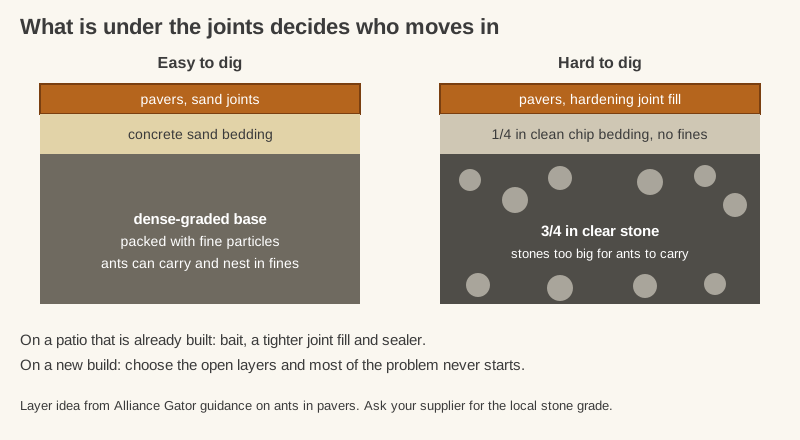
Ants nest in fine material. Howtohardscape's guide to ants in pavers points at three places: dense-graded bases, concrete sand bedding and sand joint fill. A dense-graded base is full of fines, the small particles that make it pack hard, and ants can carry fines.
The prevention side of that guide is a base with no fines. It suggests 3/4 inch crushed clear stone, topped with a 1/4 inch clean chip bedding that also has no fines, because the stones are too big for ants to carry and nest in. A synthetic base panel is another option. Neither is a repair you can make under a finished patio, which is why this section is mostly for people about to build. If you are, our guide to paver base covers the standard layers, and you can weigh the open-graded alternative against them.
One caution from the same source: a resin-based jointing compound needs an open-graded or synthetic base, because it is permeable. Do not use it over a dense-graded base.
Harden the joints so there is nothing left to dig
For a patio that already exists, joints are your repair. Plain sand stays loose, which is what ants want. NT Pavers' guide to weeds, ants and settling, say polymeric sand removes the tunneling space because it hardens when wet, and resists washout when activated correctly.
The numbers matter, and they come from the data sheets:
- Techniseal HP NextGel and Alliance Gator SuperSand G2 both call for a minimum joint depth of about 1 1/2 inches.
- Finish the sand at least 1/8 inch below the paver top.
- Install above 32 degrees F, and Techniseal asks for 48 hours above freezing.
Shallower joints do not hold the product well, so do not force it into a narrow gap. Remove the weeds, clean the joints, sweep the sand in dry, compact, and activate it with a light mist. Our how to apply polymeric sand guide has the sequence, and how to re-sand pavers shows how to prepare joints that already hold old sand.
Hardening sand deters ants rather than making the patio ant-proof. Howtohardscape is honest that it has to be replaced as it breaks down.
Sealer as the second barrier
Sealing makes it harder for ants to open the joints up again. Howtohardscape says the sealer can go on at least 30 days after installing polymeric sand, which matches Techniseal's natural look sealer sheet. Pestideas suggests reapplying every 3 to 5 years, the same rule of thumb Belgard gives for sealers in general. Sealing the patio also helps hold the sand in place.
When ants have already left a dip
Ants working under pavers can remove enough material to create voids. NT Pavers links that to pavers settling, and its summary is the line I would put on a poster: "Poison treats symptoms, but strong structure removes habitat."
If one area is sagging, treat the colony first, then lift the pavers and rebuild the dip. Our guide to fixing sunken pavers walks through rebuilding the bedding.
Ants getting into the house
Pestideas notes that ants can use cracks in slabs, floors and the foundation to get indoors. Follow the trail to its source, seal the gaps you find, and put bait at the entry point. Keep the patio clear of food crumbs and spilled drinks while the colony is being treated, because a sweet trail is competing with your bait.
Starve the nest, then close the joints
The long fix is simple: kill the colony slowly with bait, harden the joints with polymeric sand, seal after the waiting time, and if you are building new, pick a base with no fines. Spraying the visible ants buys you a quiet afternoon and nothing more.
FAQ
Why are there ants coming up between my pavers?
Ants nest in the loose bedding sand and joint fill under pavers, and the piles of sand you see are spoil from their tunnels. A dense-graded base and sand joints give them easy digging.
What is the best way to kill ants under pavers?
Slow-acting bait is the usual recommendation because workers carry it back to the nest, including the queen. Spraying only the visible ants rarely reaches the colony, and some sprays can stain pavers.
Will polymeric sand stop ants?
It deters them. Polymeric sand hardens when activated, which removes the loose material ants need to tunnel, but it breaks down over time and needs replacing. It works best with a sealer and a well-built base.
Can ants damage a paver patio?
Yes, indirectly. Ants carrying material out of the bedding layer leave voids, and the pavers above can settle, which shows up as dips and rocking units.
Does sealing pavers keep ants away?
Sealing helps block the joints and hold the sand in place. Pestideas suggests resealing every 3 to 5 years, and Howtohardscape says to wait at least 30 days after polymeric sand before sealing.


