

Last Updated on October 20, 2026 by Umar Farooq
A paver base in wet soil is built in three moves: stop the water, replace what is soft, then make the base thicker than the textbook minimum. Don't compact over standing water or mud, because ICPI Tech Spec 2 says the 98% compaction target may not be achievable on saturated soils and that the subgrade may need stabilizing. Dig out the soft spots, lay geotextile, add 2 to 4 inches to the usual 4-inch patio base, and give the water somewhere to go. If the soil is only wet from last week's rain, the fix is a tarp and patience.
Wet ground is the single most common reason a patio build stalls, and it is also the reason some patios fail two winters later. The difference is whether you built on the mud or dealt with it. Clay is covered separately in paver patio on clay soil; this article is about wet, whatever the soil.
Wet this week, or wet all year?
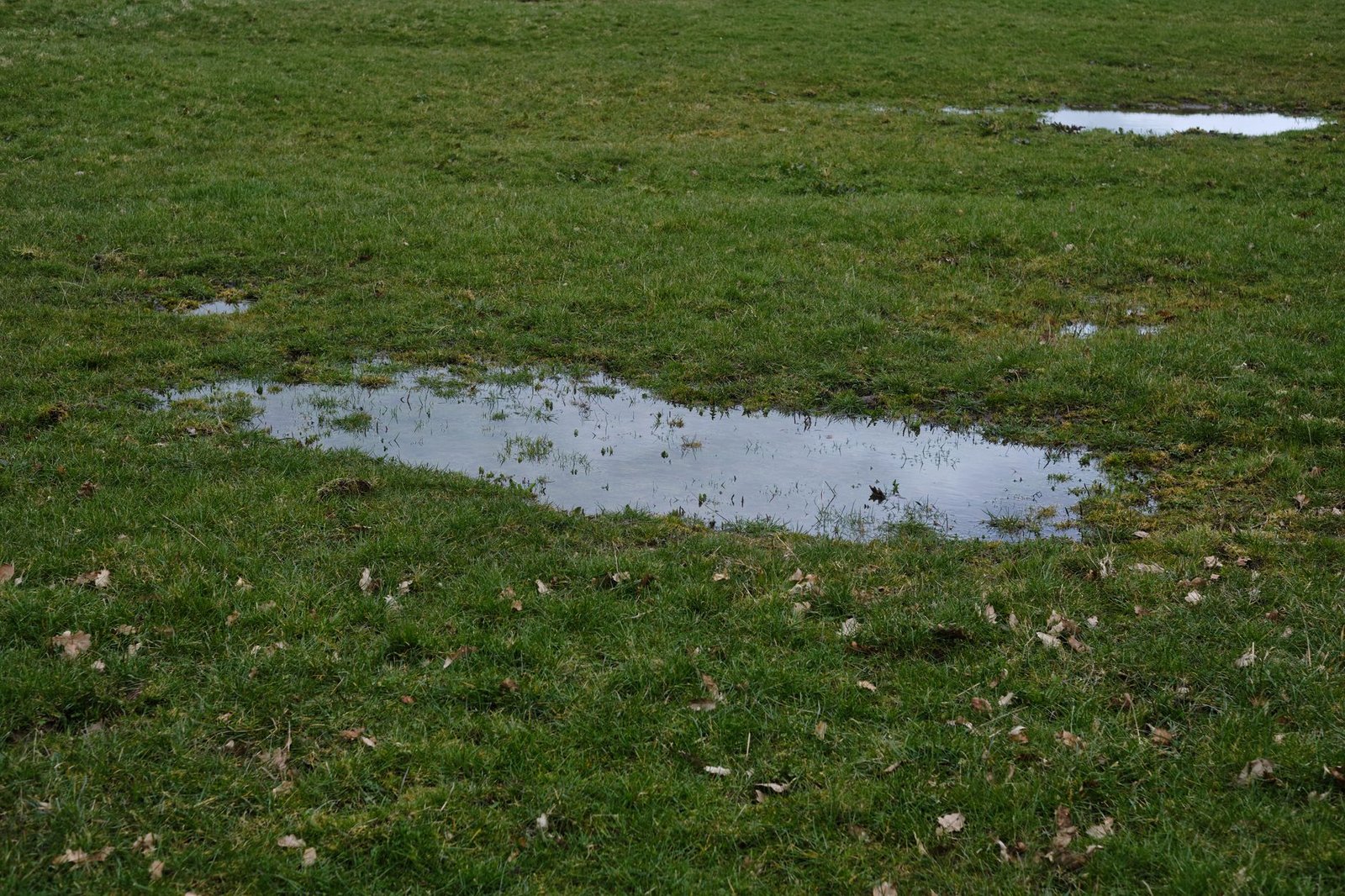
These are different problems with different fixes.
- Wet because it rained. The ground drains, just slowly. Time and a tarp solve it.
- Wet because it is low. Water from the yard or the roof flows toward the spot and stays. The fix is drainage, not patience.
- Wet because it is soft. There is no standing water, but the soil is spongy underfoot. Bladesdirect's guide to compacting after rain notes that gravel can look stable while the soil underneath stays soft, which causes settlement, rutting, pumping and uneven support.
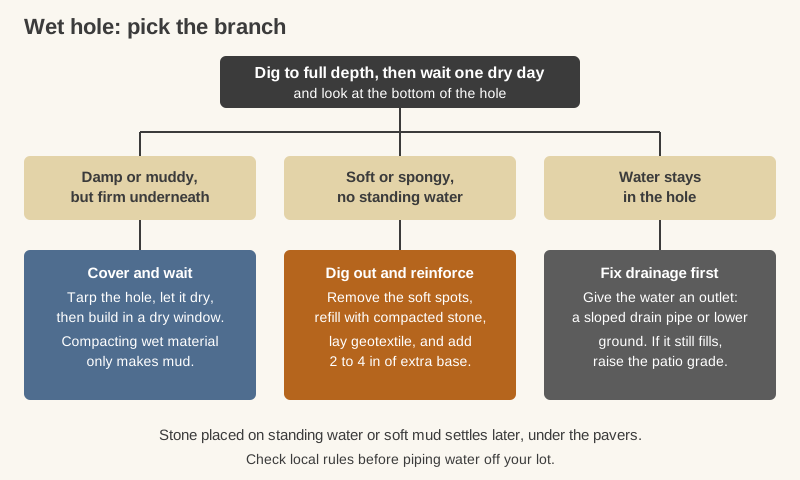
A simple test, which is my own suggestion and not a standard: dig to full depth, wait a dry day, and look. Standing water means drainage. Spongy soil means replacement. Damp but firm means wait.
Get the water out of the hole first
ICPI's instructions are blunt: free-standing water saturating the soil should be removed, and afterward low, wet areas can be stabilized with a layer of crushed stone and/or cement. That is the entire official advice on standing water, and it is why dumping base stone into a puddle is not a plan.
For a hole that keeps refilling, ICPI describes a perforated 4-inch drainage pipe in the subgrade that removes excess water from the soil and base, sloped and directed to outlets at the sides or ends of the pavement, with the outlets screened to keep animals out. It says drain pipes are recommended in clay or slow-draining soils subject to vehicular traffic. For a patio, the same logic applies whenever the water has nowhere else to go, so long as the pipe has an outlet lower than the hole. See paver drain for how outlets and fall work.
Check the roof first. A downspout dumping at the patio edge makes a perfectly dry site wet, and moving it costs less than any drain. Do this before you dig, not after.
Wait for the soil before the schedule
My opinion, and it is also the cheapest option: let the ground dry. A tarp and three dry days cost nothing, and compaction on saturated material gains you nothing. Bladesdirect says that if water rises to the surface during compaction, the material is likely too wet and more compaction adds little benefit. ICPI says the soil should be moist without visible signs of water, stick together as a ball when squeezed and break into a few pieces when dropped from 6 to 12 inches.
There is no universal waiting time, either. Bladesdirect lists rainfall, temperature, humidity, wind, sun exposure and soil drainage as the variables, so inspect the material rather than counting days. For the full moisture routine, see compacting soil.
If you are renting a plate compactor, book it for a weekend the forecast says will be dry, and don't start the job just because the rental is on the driveway. A compactor on wet ground is an expensive way to rearrange mud.
What soft ground changes in the build
| Condition | What to change | Source |
|---|---|---|
| Continually wet or weak soil | Add 2 to 4 in to the base (4 in is the patio minimum) | ICPI Tech Spec 2 |
| Saturated or very fine soil | Stabilize the subgrade if 98% standard Proctor isn't reachable | ICPI Tech Spec 2 |
| Soil that stays saturated part of the year, or clay and moist silt | Geotextile under the base | ICPI Tech Spec 2 |
| Low-strength subgrade | Longer fabric overlaps: 3 ft or sewn seams on the softest soils | ICPI Tech Spec 2, Table 3 |
| Weak soil under heavy use | Consider geogrid as well | see geogrid for pavers |
ICPI explains why fabric earns its place here: as a separation layer it prevents the migration of soil into the aggregate base under load, especially when the soil is saturated, which reduces rutting and preserves the base's load-bearing capacity for longer. The spec's minimum down-slope overlap is 12 inches.
Unilock adds the cosmetic cost of ignoring moisture: water held in the soil can wick up and discolor pavers, and in very wet climates encourage moss and mold.
How deep the dig goes on wet ground
Here is the arithmetic, which is mine and not a source's. A 2 3/8-inch paver, 1 inch of bedding sand and a 4-inch base total about 7 3/8 inches. Add ICPI's extra 2 to 4 inches of base and the excavation is roughly 9 3/8 to 11 3/8 inches below finished grade, before you dig past the edges for the restraint. That is a lot of spoil from a hole that is already unpleasant, so line up a place to put it, because wet soil dumped beside the excavation tends to slide back in.
Choosing paver base stone for wet soil
Sources disagree here, and it's worth saying so. ICPI's spec lists a dense-graded aggregate, whose gradation includes fines. The clay article on this site, drawing on Unilock and Rochester Concrete Products, steers toward clean open-graded stone that drains freely. Bladesdirect's guide has a section on why fines matter for compaction, and lists well-draining aggregate among its drainage measures.
My reading is that dense-graded stone compacts better but holds water, and open-graded stone drains but needs a place for that water to go. If you have an outlet, either can work. If you don't, neither will. Ask your local supplier which base they sell for wet sites, and see paver base material.
Keeping the work dry
- Slope the subgrade. ICPI sets 1.5% as the minimum slope, so water runs off the surface instead of soaking in.
- Work in sections you can finish. Stone laid on wet subgrade and left open overnight will take on rain.
- Cover what you can't finish. Tarp piles and open areas, and keep wheelbarrow traffic off the soft ground.
- Skip saturated sand. ICPI says frozen or saturated bedding sand should not be installed. In wet weather, keep the sand pile under a tarp.
Dry hole, firm bottom, deeper base
Building a paver base in wet soil is mostly about not rushing. Find out whether the ground is wet for a week or for the year, get standing water out, replace soft spots, lay geotextile, add the extra 2 to 4 inches and keep the water moving. The pavers will look exactly like they would on dry ground, which is the point. Nobody ever admired a patio for how well it handled a wet March, and everybody notices the one that didn't.
FAQ
Can you lay a paver base on wet soil?
Not directly on mud or standing water. Remove free-standing water, let the ground dry until it passes the squeeze test, or stabilize low wet spots with crushed stone, per ICPI Tech Spec 2. Then build a thicker base.
How much extra base do you need on wet soil?
ICPI says continually wet or weak soils need bases at least 2 to 4 inches thicker than the 4-inch minimum for patios and walkways on well-drained soil.
How long should you wait after rain to build a paver base?
There is no fixed number. Drying depends on rainfall, temperature, wind, sun and soil drainage, according to Bladesdirect, so check the soil by hand. It should be moist, not muddy or shiny.
Do I need geotextile fabric under pavers on wet ground?
Usually yes. ICPI says geotextile can be used where soil stays saturated part of the year, where it freezes and thaws, or over clay and moist silty soils, because it keeps soil from mixing into the base.
What if the hole keeps filling with water?
That is a drainage problem, not a compaction problem. Find the water source (often a downspout), give the water an outlet or a sloped perforated drain pipe, and if it still won't drain, talk to a local pro about raising the patio.


