


Last Updated on October 20, 2026 by Umar Farooq
Pavers heaving in winter is almost always water freezing in or under the base, then lifting the surface in patches that drop unevenly when it thaws. Fix it by resetting the raised pavers on fresh bedding sand for small spots, rebuilding the base where the ground is soft, and then removing the water. Resetting alone only buys you until the next freeze if the water is still there.
I read two long guides on this, one from a repair site and one from a paver manufacturer. They agree on more than I expected, and the shared message is that frost heave is a water problem wearing a winter coat.
Is it frost heave, or something else?
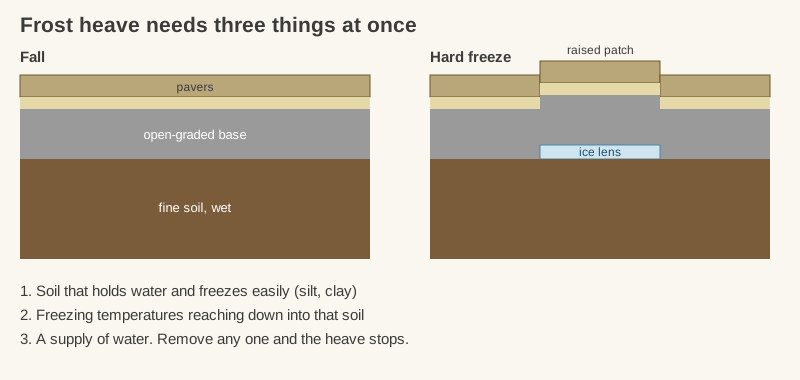
Rochester Concrete Products, citing Federal Highway Administration guidance, names three conditions for frost heave: frost-susceptible soil, freezing temperatures and a source of water. The diagram shows the mechanism. Water in fine soil under the base freezes into a lens of ice, which pushes a patch up. When it thaws, the patch drops back, not always to where it started.
A few clues that point to heave rather than other movement:
- It showed up after a freeze, and often shifts again in spring. Pure settlement, covered in pavers settling after installation, only goes one way: down.
- The raised patch sits over soil that stays wet. Look at clay, low spots and downspout outlets.
- Joints are open or sand has dropped around it. Empty joints, Journeyman HQ says, "act as funnels that direct water straight into the base."
- It comes back every winter in the same place. That is a drainage and base signal, not bad luck.
If a single paver is high with no pattern, it may just be a loose unit. For sunken or dipping areas, how to fix sunken pavers is the better match.
Take away one ingredient and the heave stops
Journeyman HQ puts it bluntly: "Frost heave is impossible without water." You cannot change the climate or, cheaply, the soil, so water is the lever. The checks below, in order of cost:
- Where do downspouts and sprinklers discharge? Move them away from the patio.
- Does water stand on the surface? Journeyman HQ treats more than an hour of standing water as a sign you need drainage work. That is the author's rule of thumb, not a published standard.
- Are the joints full? Refill them.
- Is the surface pitched away from the house? The minimum pitch is 1.5% (ICPI Tech Spec 2), or 2% near the foundation (IRC R401.3), about 1/4 inch per foot.
- Is the base clay-ish or tight? That is where open-graded stone and fabric come in.
Our patio drainage guide has the drain options.
Fix a single popped paver
For one raised unit, lift it out, scrape out the old sand, add fresh bedding sand and reset it. Journeyman HQ says the replaced paver should sit about an eighth of an inch high before you tap it down, which matches the 1/8 to 1/4 inch settlement allowance CMHA's guide spec uses for new work (CMHA PAV-GSP-011-21). A mallet and a level are the only tools you need.
Do not shim a paver up with extra sand to make it match. A quick shim fixes the trip hazard for a week and tells you nothing about why it moved.
Fix a cluster of raised pavers
Lift the whole patch, not just the highest unit. Screed fresh sand to one inch, loose and uncompacted, then relay the pavers. The sand is never a leveling layer for a bumpy base. If the base underneath is not flat, you are in the next section.
Rebuild the base where it is soft or spongy
If the ground under the lifted pavers is wet, soft or full of fines, repairing the sand won't hold. Journeyman HQ's approach is to dig out four to six inches and rebuild in two-inch lifts. That is cautious compared with ICPI's 4-to-6-inch lifts, but ICPI's number assumes a 7,000 lbf plate and calls for thinner lifts with smaller ones, which is what a rental yard usually hands you. Thin lifts are the right call.
Rochester's guide separates two kinds of base:
- Dense-graded base with fines, which compacts well but holds water.
- Open-graded stone, with few fines, which drains and resists heave.
For an area that heaves every winter, the open-graded choice gives water somewhere to go. Make sure it leads somewhere, such as a lower edge or a drain, or you have built a bathtub. See paver base for depths: at least 4 inches for a patio, 6 for a driveway, plus 2 to 4 inches on wet or freezing ground (ICPI Tech Spec 2).
Map the heave before you touch it
Before you lift anything, spend ten minutes mapping what moved. Lay a long straightedge across the raised area, measure the gap with a ruler, and note it with the date. Mark the edges of the raised patch with chalk and photograph it. This is my own routine, not a published one, but it gives you something to compare against in spring and tells you whether you are dealing with a one-off lump or a pattern. It also gives you numbers to hand an installer or manufacturer if the pavers are still under warranty.
Three things to note on the map: where the water goes (stand there during rain), what the soil is like beside the patio (clay holds water, sandy soil drains), and whether the raised patch lines up with a downspout, a tree or a low spot. If you can answer "yes" to one of those, you have found your water.
Pavers flex, slabs crack: why this is a fixable problem
A poured slab that gets heaved tends to crack and stay cracked. Interlocking pavers move as separate units and can be lifted, rebuilt underneath and put back where they came out, which is the quiet superpower of pavers over concrete. Rochester's guide devotes a whole section to comparing slabs and interlocking pavers when the base moves, and the logic is the same: a segmented surface tolerates some movement and a rigid one does not. A heaved patch is an afternoon's work, not a replacement. See paving stones or concrete if you are weighing a slab.
Tools: rent the compactor or skip it
Journeyman HQ's tool advice is refreshingly cheap. A mallet, a level, a pry tool and a straightedge cover most spot repairs, and it says a plate compactor is unnecessary if you are resetting fewer than twenty stones. That is the author's judgment, and I agree with the direction: do not buy a compactor for a few pavers. For a rebuilt base, rent a plate for a day, and make sure its size suits the lift thickness you are using.
Re-lock the edges and joints
Ice pushes the outer row sideways a little every winter. If the edge restraint has loosened, Journeyman HQ suggests resetting it with 10 or 12 inch galvanized spikes. Once the field is flat and tight, sweep in new joint sand or polymeric sand.
When spot repairs stop making sense
Journeyman HQ says that if more than 30% of a patio is shifting, you should consider a professional reset rather than spot repairs. That figure is the author's rule of thumb and I could not find it in a standard. The logic holds, though: if a third of the field moves every winter, the cause is the whole base or the whole site's water, not a few loose units. A full rebuild with a deeper open-graded base is the fix, and a contractor with a plate compactor makes it a weekend rather than a month.
Prevent the next one
- Dig 2 to 4 inches deeper than usual on wet, weak or freezing ground (ICPI Tech Spec 2). Our sibling guide pavers in cold climates has the full table and freeze-thaw ratings, so I won't repeat it here.
- Compact in thin lifts and keep the base clean of fines.
- Send roof and irrigation water away from the pavers.
- Use a geotextile fabric over clay so stone and soil don't mix.
- Do not use a thicker bedding layer as a fix. Rochester lists "Don't Use Bed to Fix Base Mistakes" as its own heading, which says everything.
- Walk the patio each spring and mark any high spots with chalk, so you catch heave early.
Fix the water, then fix the pavers
The raised pavers are a symptom, so start with where the water comes from, then rebuild only as deep as the problem goes. A reset costs a weekend. A reset that ignores the water costs the same weekend every March. Get the downspout moved, and the pavers can go back down for good.
FAQ
Why are my pavers heaving in winter?
Water in the soil under the base freezes, expands and lifts the surface. Frost heave needs frost-susceptible soil, freezing temperatures and a water source, and removing any one stops it.
Will heaved pavers go back down on their own?
Sometimes they drop back when the ground thaws, but not always to level. If the raised area stays high or returns every winter, plan a reset and fix the drainage.
Can I fix heaved pavers myself?
Single units and small clusters, yes, with a pry bar, bedding sand, a screed board and a mallet. A large area is a base rebuild, and Journeyman HQ suggests considering a pro if more than 30% is shifting.
How do I stop pavers heaving every winter?
Move water away, use a deeper open-graded base on wet or freezing ground, keep joints full and make sure the surface slopes. Dense base with fines holds water and is more likely to heave.
Is frost heave covered by a paver warranty?
It depends on the maker and the installer. Read the document.


