


Last Updated on October 20, 2026 by Umar Farooq
Cracked pavers almost always mean the support under the paver or the paver's own proportions are wrong, not that the paver itself is cursed. A crack across one unit with the neighbors still flat usually points to a hollow spot in the sand bed or a point load. Several cracked units in one area point to a base that settled. Replace a single cracked paver by lifting it, fixing the sand underneath and setting a new one, and only then worry about the cause, because the same cause will crack the replacement.
I went looking for a clean "cracks mean X" chart and could not find one from a primary source, which is a polite way of saying the top results mostly agree with each other and cite nothing. So this page sticks to what the spec numbers and the repair guides I opened actually say, and labels my own reasoning as mine.
Read the crack before you reach for the chisel
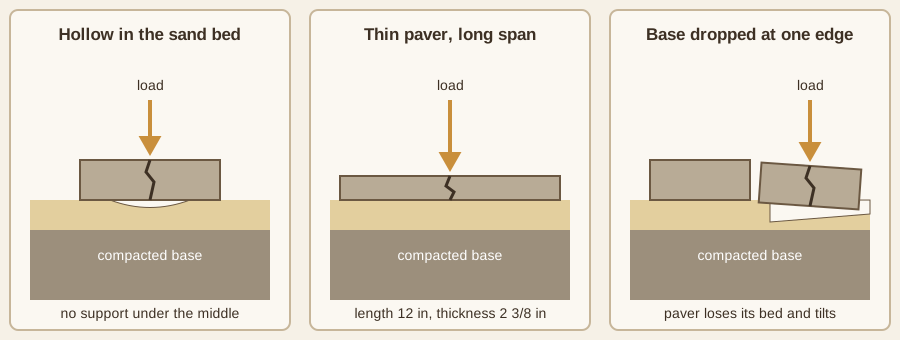
Where the crack sits tells you more than how wide it is. Three patterns cover most of what homeowners ask about.
- One paver, one crack, neighbors still level. Think of a hollow or a high spot under that single unit. Ask the Builder's repair guide notes that bricks sit high where the sand is too deep and low or hollow where it is too thin, which is exactly the uneven support that makes a paver flex under a load until it snaps.
- A cluster of cracked or tilted pavers in one zone. The base has probably dropped there. The unit is cracking because it is no longer supported evenly, so fixing the paver alone is a short-lived repair. See how to fix sunken pavers.
- Cracks that follow the wheel path or the corner of a vehicle turn. Suspect the paver's proportions or a base that was built for feet, not trucks. More on that in the next section.
A hairline in an otherwise flat, tight paver is a cosmetic problem. My opinion, backed by the mechanism: pavers hold the surface together through interlock between units, not through the strength of any one unit, so a sound hairline in a paver that sits level with its neighbors is not worth lifting. A crack with a step in it is.
When the paver was the wrong shape for the job
Some cracking is baked in before the first shovel goes in. CMHA's Tech Spec 10 gives the rule of thumb on aspect ratio, which is length divided by thickness. A ratio of 4:1 or more should not be used where vehicles drive, between 4:1 and 3:1 is fine for limited car use such as a residential driveway, and 3:1 or less suits all vehicular use. The same document recommends 2 3/8 in (60 mm) thick pavers for pedestrian areas and residential driveways.
Do the arithmetic on a common patio slab. A 12 x 12 inch paver that is 2 3/8 inches thick has an aspect ratio of about 5. That is a perfectly good patio paver and a poor choice under a pickup. The big, thin unit has a long span and little depth, so a tire load that a smaller paver would shrug off bends it. If you are unsure what you have, check the paver thickness guide and the notes on 12×12 pavers.
Pavers also have to meet a standard. ASTM C936 asks for an average compressive strength of 8,000 psi with no single unit under 7,200 psi (as quoted in CMHA's guide specification PAV-GSP-011-21). A decorative or reclaimed unit that never met that standard has no such promise behind it.
Base and sand problems that crack pavers from below
If the paver was the right one, look underneath. The numbers to compare against, all from CMHA and ICPI documents:
| Layer | Spec | Why a miss cracks pavers |
|---|---|---|
| Compacted base, patios and walks | at least 4 in (ICPI Tech Spec 2) | A thin base lets the soil beneath move, and the paver follows |
| Compacted base, residential driveways | at least 6 in (ICPI Tech Spec 2) | Wheel loads reach deeper than foot loads |
| Bedding sand | nominal 1 in, screeded, uncompacted | Deep pockets compress unevenly and leave hollows |
| Base surface flatness | within 3/8 in over a 10 ft straightedge (CMHA) | A lumpy base turns the sand bed into the leveling layer |
| Lippage between pavers | 1/8 in maximum on pedestrian routes (ICPI) | A proud edge takes the hit and snaps at the joint |
The one I would check first is the sand. "Just add more sand to the low spot" is the oldest shortcut in the book, and the sand bed is one inch, loose and screeded, not a leveling layer. Two inches in a dip compresses more than one inch everywhere else, which leaves exactly the kind of hollow that cracks a paver under a heavy foot or a table leg. I read the CMHA spec twice to see whether it hedged on this. It says "Do not disturb screeded sand" and moves on.
In cold climates the extra 2 to 4 inches of base in the ICPI spec is there for a reason. If your patio lives where the ground freezes, read pavers in cold climates.
Impacts, point loads and the day someone dropped the grill
Dropped objects, a jack stand, a trailer tongue or a metal ladder foot can crack a paver that is otherwise doing nothing wrong. A paver is strong in compression across its face and much weaker when one corner takes a sharp load while the sand underneath is soft or hollow. The cure is mostly behavioral: wide plywood under jack stands, no sharp loads on the field. I could not find a published number for how much point load a typical paver takes, so I am not going to make one up.
If a crack appears only where something heavy always sits, move the thing or spread its load before you replace the paver. Otherwise you will be doing this again in a year.
Replace one cracked paver without disturbing the rest
A single replacement is an afternoon, and the pavers around it go nowhere, which is the quiet advantage of pavers over a poured slab. The full walkthrough is in paver patio repair and how to remove pavers. In short:
- Photograph the pattern. Mark which way the paver faces so the new one drops back into the same orientation.
- Break the cracked paver out from the middle. The repair guide I read drills a row of 3/8 inch holes into the center of the brick, then chips toward the center with a chisel so the neighbors stay intact.
- Fix the bed. Remove the old sand, check the base, and smooth about an inch of sand level with the bottoms of the surrounding units. Tamp it with a short piece of 2×4 if you do not have a small compactor.
- Set the new paver slightly proud. Ask the Builder suggests leaving the sand about 1/4 to 3/8 inch above the bottom of the correctly set bricks, then tapping the new unit down with a rubber mallet and checking with a level or straight board. CMHA says pavers may sit 1/8 to 1/4 in above final grade before compaction, so aim for a hair high rather than flush.
- Sweep sand into the joints. Use the same type that is already there. If the field used polymeric sand, see how to apply polymeric sand.
New pavers look brighter than weathered neighbors for a while. Taking a cracked unit to a dealer for a match helps, and so does keeping a few spares from the original order. (Spares kept in the garage are the single cheapest insurance in hardscaping, and almost nobody does it.)
Prevent the next crack
You do not need to rip anything up to cut your crack risk. Four checks cover most of it:
- Keep heavy points off the field: jack stands on plywood, no trailer tongues resting on pavers.
- Confirm the paver suits the load. Thin, large units belong on patios, not driveways.
- Keep joints full. Sand that washes out leaves the paver edges unsupported, which is why polymeric sand problems show up in crack reports.
- Fix drainage. Water that sits under the field softens the base, so check patio drainage if the same zone keeps cracking.
Replace the paver, then fix whatever cracked it
A cracked paver is a symptom with a cheap treatment and an expensive cause. Swap the unit, correct the sand or the base beneath it, and match the paver to the load. If you do that, the new one will outlast the cracked one, and your grill can finally stop being the main suspect.
FAQ
Why are my pavers cracking?
The usual causes are uneven or hollow bedding sand, a base that settled or was built too thin, a paver that is too thin for its footprint under vehicle loads, and sharp point loads. One cracked unit among level neighbors suggests a bed problem under that unit. A group of cracks suggests the base moved.
Can I repair a cracked paver or do I have to replace it?
A hairline in a level, tight paver can often be left alone. A paver with a crack that has stepped, spalled or moved should be replaced, because the crack will keep growing under traffic.
How do I replace one cracked paver?
Break the old paver out from the center so the neighbors are not chipped, fix the sand underneath, set the new paver slightly proud, tap it flush with a rubber mallet, and sweep sand into the joints.
Why do pavers crack on a driveway?
Often the paver is too thin for its size. CMHA says a length-to-thickness ratio of 4:1 or more should not be used where vehicles drive, and that 2 3/8 in pavers are fine for residential driveways when the ratio is within limits. A base thinner than 6 in compacted also contributes.
Will sealing stop pavers from cracking?
No. Sealer changes how water and stains behave on the surface. It does nothing for a hollow bed or a thin paver, so see paver sealing for what it does do.


