

Last Updated on October 20, 2026 by Umar Farooq
Paver patio flooding almost always comes from one of four places: roof water from a downspout, runoff arriving from higher ground, a patio surface that falls toward the house, or a low spot where the base settled. A ten-minute hose test on a dry day tells you which one. Fix that source first, because adding a drain to a patio that is fed or pitched wrongly just gives the water a nicer place to sit.
This page is about diagnosis. The slope numbers and the drain hardware already live in patio drainage and paver patio slope, and I will link to them rather than repeat them.
Does it flood every rain, or only in storms?
The pattern points at the cause before you pick up a tool.
| What you see | Likely cause |
|---|---|
| Puddles after any rain, same place each time | A low spot or a flat patio |
| Only floods in a heavy downpour, and one corner first | A downspout or gutter overflow dumping at the patio |
| Water flows onto the patio from the lawn or a slope | Runoff from higher ground |
| Water runs to the house wall and stops | The surface falls toward the house |
| Soft, wet patch with no recent rain | A leak or groundwater, not rain |
The housedigest guide I read lists the same suspects: ineffective drainage, a downspout placed right next to the patio, a clogged system, ground that has settled and flattened the slope, and a patio sitting lower than the soil around it (House Digest). A UK guide adds a few more that apply here: a raised edge or planter blocking the low side, a blocked outlet, and joint material that traps water (Universal Paving).
Paver patio flooding: four sources, four hose tests
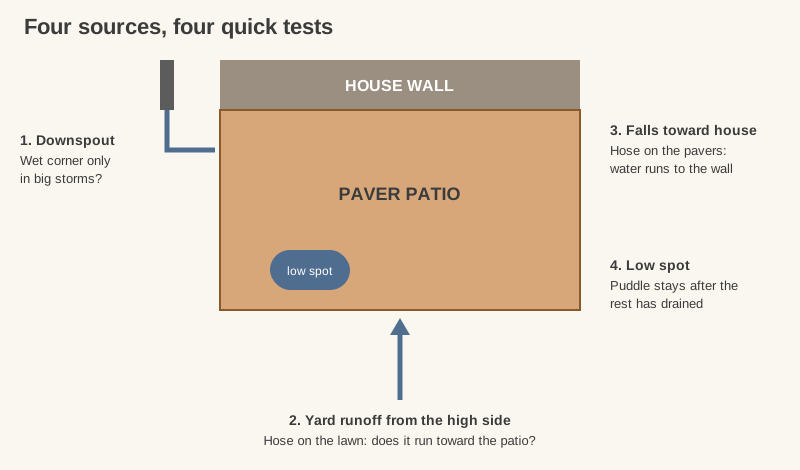
Pick a dry day and run a hose. Do not guess.
- Downspout. Run the hose into the gutter above the nearest downspout and watch where the water exits. If it lands on or beside the patio, you have found a big contributor. For scale, my own arithmetic: one inch of rain on 1,000 square feet of roof is roughly 620 gallons, and it all leaves through a few pipes.
- Yard runoff. Run the hose on the lawn above the patio. Does the water travel toward the pavers? If so, the fix is upstream of the patio.
- Falls toward the house. Run the hose along the middle of the pavers. Water that runs to the wall and stops is a slope problem. ICPI's minimum surface slope is 1.5%, and the IRC wants impervious surfaces within 10 feet of the foundation to fall at least 2% away from it, about 1/4 inch per foot. (The IRC is a model code, so check with your local building department.)
- Low spot. Water that drains everywhere except one patch, then stays there, means the base settled. Lay a straightedge across it. Even a shallow dip is enough to hold a puddle.
If the wall is the wet part, that is not a patio problem alone. Pavers around house foundation covers clearances at the wall.
Fix the cheapest source first
Match the fix to what the hose showed you:
- Downspout: extend it past the patio onto ground that can take it, or pipe it away. House Digest lists this first because it cuts the volume reaching the patio.
- Yard runoff: regrade the ground above the patio or cut a shallow swale so water goes around, not across.
- Falls toward the house: a drain along the house edge is faster than a rebuild, but a rebuild is the real fix. A channel drain at the wall protects the foundation but does not make the surface pitch correctly.
- Low spot: lift the pavers there, fix the base underneath, and relay them. Adding sand alone will not last.
Paver drain covers the drain options if the surface truly cannot shed water to an edge.
When it floods and it has not rained
A soggy patio in dry weather is not a surface-water problem. Lawnlove's French-drain guide makes the point that a boggy yard with no recent rain may be a broken pipe rather than a drainage design issue (Lawnlove). Look for a leaking spigot, irrigation line or downspout joint. If the water is groundwater, a drain around the patio is a possibility and I look at it in a separate guide. Heavy clay makes all of this worse, since it drains slowly.
What the water does to the patio
Standing water is not just a nuisance. It washes sand out of the joints and out from under the pavers, and it softens the base so it sinks. If you already see a dip, how to fix sunken pavers walks through lifting and relaying. I could not find a study that says how fast a flooded base fails, so I will not give you a number.
Fix the source, then fix the patio
Do the hose test, name the source, and fix that before buying anything. Nine times out of ten the culprit is cheaper than the drain you were about to order. Then go and stand on the patio in the next rain with a coffee and watch it work. It is the most satisfying twelve minutes in home maintenance, and the only ones with built-in sound effects.
FAQ
Why does my patio flood when it rains?
Usually because water arrives faster than the patio can shed it. The common causes are a downspout discharging nearby, runoff from higher ground, a patio that is flat or falls toward the house, and a low spot where the base settled.
How do I stop water pooling on my pavers?
Find where it comes from with a hose test, then fix that source: extend downspouts, regrade or swale the ground above the patio, or lift and rebuild the low section. Drains are for cases where slope cannot do the job.
Is a flooded patio dangerous for my house?
It can be if the water runs toward the foundation. The IRC calls for impervious surfaces within 10 feet of the foundation to slope at least 2% away from the building. Check local rules, and see pavers around house foundation for clearances.
Does rain soak through the joints of a paver patio?
A little, especially when the joints are new, but most rain sheds off the surface. Jointing compound or hardened sand can trap water, as the UK guide I read notes. Permeable pavers are the only type designed to drain through the joints.
Can a patio that floods be fixed without removing it?
Often yes. Downspouts, regrading and swales leave the pavers alone, and a low spot can be fixed by lifting just that section. A patio that falls toward the house may need a rebuild or a channel drain.


