

Last Updated on October 20, 2026 by Umar Farooq
Silica dust from cutting pavers is real, and it is the kind of hazard that does not hurt on the day. Concrete and stone contain crystalline silica, and cutting them releases particles fine enough to reach deep in your lungs. The fix is not complicated: put water on the blade for every cut, wear a proper respirator, and cut fewer pavers.
I read a regulator page, a manufacturer's safety guidance page and a long cutting guide for this. The top results are thin on silica, so this one sticks to numbers. For how to make the cuts themselves, start with how to cut pavers.
Where the dust comes from, and why it is not ordinary dust
NIOSH explains that silica is silicon dioxide, and when it forms a crystal it becomes crystalline silica. The hazard is the respirable fraction, particles small enough to get deep into the lungs. NIOSH lists concrete, brick, mortar, granite and other stone among the places silica turns up, and says cutting, grinding and drilling can release it. Pavers are not named, but they are concrete, brick or stone.
The health effects are the part that earns the attention. NIOSH's wording is plain: "Silicosis is a lung disease caused by inhaling excessive amounts of respirable crystalline silica." It also lists lung cancer, COPD and chronic kidney failure, and says the lung disease is not reversible but is preventable.
How worried a one-weekend patio should make you
Less than a crew that cuts every day, more than nothing. The numbers I can stand behind are occupational. A CDC report counted 1,437 US deaths from 2001 to 2010 with silicosis as an underlying or contributing cause, 28 of them in people aged 15 to 44 (MMWR, via PMC). Those are workers, not homeowners.
OSHA's construction standard sets a permissible exposure limit of 50 micrograms per cubic metre of air averaged over eight hours, with an action level of 25 (29 CFR 1926.1153). I found no measurement of what a homeowner breathes cutting a few dozen pavers, so I will not guess. You cannot judge it by eye either: HSE says that even if you cannot see the dust, there may be enough to harm you.
So the advice is controls, not a risk score. A control costs a hose connection and a mask.
Choose the control before the first cut

Can the saw run with water on the blade? If yes, wet cut, then check the water reaches the blade and how long the session runs. If no, the cut is outdoors with a respirator on.
Wet cutting: what "enough water" means
HSE shows the difference in two photos of the same petrol cutter: dry, it throws out a lot of dust; with a hose feeding jets on the blade, little visible dust. HSE gives no flow figures.
STIHL does. Its guidance for its cut-off machines is a minimum of 20 fluid ounces (0.6 litres) per minute to the wheel whenever silica-containing material is being cut. For one model, the GS 461, it calls for at least 22 PSI water pressure, confirmed before you start. Those are STIHL machine figures, so check your own saw's manual. On a tank, STIHL warns that pressure falls as the water level falls, so refill or re-pressurise before it runs low.
The water has to be on before the blade touches the paver, and stay on. Our wet saw for pavers and cut off saw guides cover the setups.
When wet is still not enough: the respirator question
The sources differ here.
- HSE: wear respiratory protective equipment whenever you cut stone, even with water, because some dust may still be present.
- STIHL: even at the recommended flow, an operator cutting more than two hours in a day should wear a NIOSH-approved respirator, and so should bystanders.
- OSHA Table 1: for handheld masonry saws with water, no respirator outdoors up to four hours per shift, then an APF 10 respirator beyond that. Stationary masonry saws with integrated water need none. Indoors, a handheld saw needs APF 10 at any duration. OSHA's rule is written for employers; see 29 CFR 1926.1153.
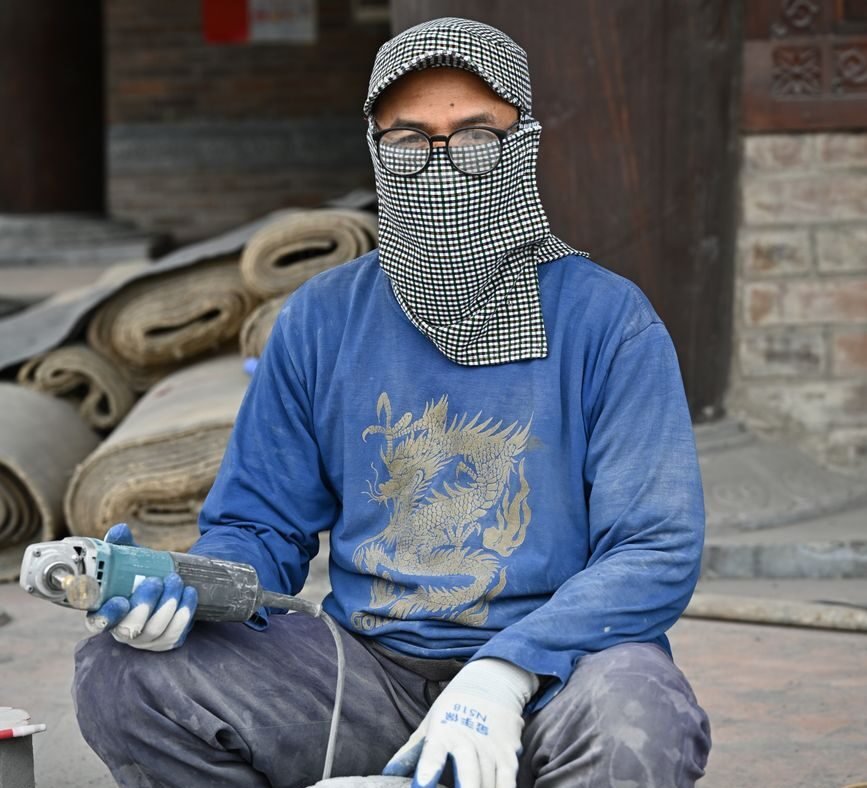
Three sources, three thresholds. I would take the HSE one: wear the respirator every session, because it costs far less than being wrong. A cloth face covering is not what STIHL or OSHA means by one (the worker in the photo at the top has the right instinct and, as far as a scarf goes, the wrong filter).
Dry cutting: the last resort
If you must cut dry, do it outdoors with people and open windows well away, keep it to the few cuts that cannot wait, and wear the respirator. I could not source anything on dust collectors from a page I opened, so I will not promise they fix it.
The other option is to avoid the dust. A splitter breaks a paver along a line instead of grinding it; our paver splitter guide covers when it works. Every cut you skip is dust you do not breathe.
Water on the blade, mask on the face, fewer cuts
My opinion, backed by the mechanism: lay the whole field first, cut only the edges, and make every one of those cuts wet. Cutting is the one part of a patio job that puts something harmful in the air, and it is also the part you can shrink by planning the layout around full pavers. The silica in the paver does not care that it is a Saturday.
If the saw is already running and the hose is still coiled in the garage, stop, connect it, then carry on.
FAQ
Is silica dust from cutting pavers dangerous?
Yes. Cutting concrete, brick and stone releases respirable crystalline silica, and inhaling too much causes silicosis, which cannot be reversed but can be prevented (NIOSH).
Does wet cutting remove the silica risk?
It cuts it a lot, not to nothing. HSE shows little visible dust with water on the blade, but says some may remain, so it advises respiratory protection whenever you cut stone.
How much water do I need for wet cutting?
STIHL specifies at least 20 fluid ounces (0.6 litres) per minute to the wheel on its cut-off machines when cutting silica-containing material. Check your own saw's manual, since flow figures are machine-specific.
Do I need a respirator to cut pavers?
Sources differ on when. HSE says always for stone, STIHL says over two hours a day (and for bystanders), and OSHA's table for handheld masonry saws outdoors says beyond four hours. Wearing one for every session is the simple answer.
Can I cut pavers indoors?
Avoid it. OSHA's table requires a respirator at any duration for a handheld masonry saw indoors, and gas saws add carbon monoxide (how to use a concrete saw). Cut outside.


