

Last Updated on October 20, 2026 by Umar Farooq
Puddles on paver driveway surfaces are almost always a low spot, not a leak: a dip where the base or sand has settled, or a stretch where the surface stopped falling toward an exit. The first job is cheap. After the next rain, chalk around each puddle while it is full and measure how deep the dip is. Where the puddle sits tells you the cause, and the cause decides whether you sweep, redirect, or lift and rebuild.
A puddle that is gone within hours is the driveway working. One that is still there the next morning is a message.
Decide whether it is a problem at all
Not every wet patch needs work. The asphalt contractors whose pages I read give rough triggers: one says water still standing 24 to 48 hours after rain is a reason to have the driveway inspected, and another says water that sits for hours deserves attention. Those are asphalt pages with no paver data, so use them as a prompt to look, not as a standard.
My own rule: a thin film that dries out within hours on a hot day is wet pavers. A pool that is visibly deep, holds for a day, or grows every rain is a defect.
Read where the puddle sits
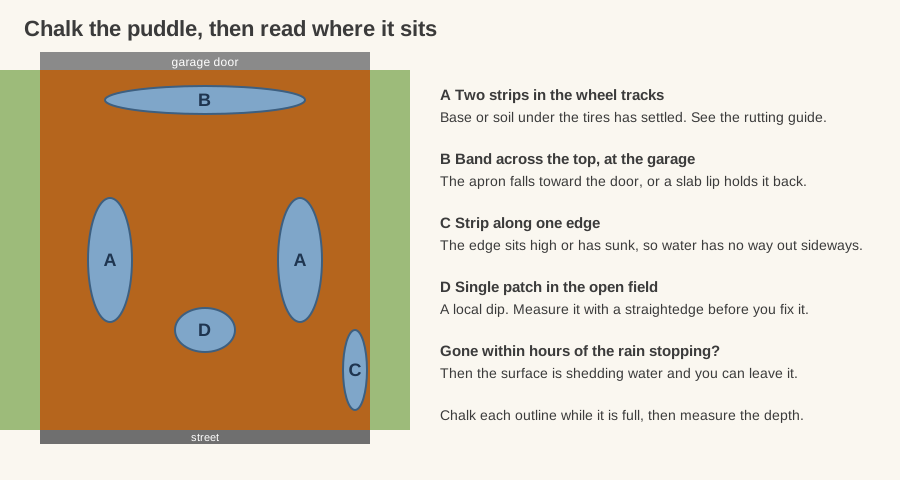
Chalk each outline while it is full, then measure the dip when it is dry: lay a straight board across it and measure the gap at the deepest point. For scale, CMHA's spec lets the finished base vary by 3/8 inch over 10 feet, and ICPI's limit for the step between neighboring pavers on a pedestrian route is 1/8 inch. A dip deeper than those is not construction noise.
- Two strips in the wheel tracks. The base or soil under the tires has settled. This is our driveway pavers rutting page, and the fix is lift and rebuild.
- A band across the top, at the garage. The apron falls toward the door. See driveway water into garage.
- A strip along one edge. The edge may have sunk or sit high, so the water has no way out sideways.
- One patch in the open field. A local dip. Measure it, then lift it.
- Water arriving from the yard, a downspout or the street. Fix that source first.
Why a paver driveway holds water
ICPI Tech Spec 2 gives a minimum surface slope of 1.5%. Anything flatter, or any dip that interrupts a slope, can hold water. Both pages on asphalt list the same families of cause: no consistent pitch, settlement from a base that was not compacted well, and extra water arriving from elsewhere.
A permeable-paver company's explainer (LC Paver) makes one useful point, though it is a company page with no numbers: joints must stay open, because dirt and debris reduce permeability over time. That only matters if your driveway is permeable. A conventional paver driveway sheds water by slope, with the joints as a minor extra, which is also the stance of our is polymeric sand permeable page.
Fixes, ranked from cheapest to most work
- Redirect water arriving from elsewhere. A downspout aimed at the driveway or a yard that slopes onto it creates puddles that no paver fix will cure. Check this first.
- Clear what blocks the exit. Sweep leaves, mulch and grit off the surface and out of any edge or drain, so the water can leave along the slope you already have.
- Top up the joints. If the joint sand has dropped well below the paver edge, sweep fresh sand in. This helps with water flowing, but it does not raise a dip.
- Lift and relay the dip. For a dip of up to a few square feet, lift the pavers, fix the base underneath, screed 1 inch of loose sand, relay, and re-sand. Our how to fix sunken pavers guide has the steps.
- Add somewhere for water to go. Where the grade cannot change, a swale, a channel drain or a catch basin gives the water an exit. See patio drainage for options that work as well on a driveway.
- Rebuild the area. If the low spot is wide, the base is failing, or the fall is wrong along a long stretch, lift and rebuild the base with the correct pitch. Both asphalt contractors say the same in their own words: filling the low spot rarely fixes a grade problem.
My one opinion, with the mechanism: do not fix a birdbath by sweeping extra sand into it. Sand is the soft layer. A thicker pad of it in the lowest spot compresses faster than the sand around it, so the dip tends to come back, and the standard is a nominal 1 inch of loose sand (ICPI Tech Spec 2). Cheaper than any of that: spend the first rain with a piece of chalk.
Where a DIY fix should stop
- The water heads for the house or garage, or a neighbor's property.
- The low spot is wide, or it comes with cracked pavers or a leaning edge.
- You need to connect a drain to a storm sewer or send water to the street. Many places control that, so ask the municipality.
- Utilities run under the dip. Call 811 before you dig, and hand-dig near the marks.
Fixes that look busy but do nothing
- Sand in the dip. See above.
- Sealer on the surface. Sealing changes how the surface looks and stains, not how it drains. I found no source that says it fixes ponding.
- A new drain with no outlet. It collects the puddle in a bucket.
Keep the surface falling
Keep an exit open, keep the base compacted in lifts, keep 1 inch of loose sand, and re-check after each hard rain for the first season. Puddles are easy to read in the first year and hard to ignore in the fifth.
Chalk first, lift last
Puddles on a paver driveway have a cause you can see from above, a dip you can measure with a board, and a fix that mostly starts cheap. Chalk it, measure it, redirect what you can, and lift only what is actually low. The driveway will not complain about being asked to drain.
FAQ
Why do I have puddles on my paver driveway?
Because part of the surface is lower than the stretch downhill of it. The usual causes are a settled base or sand, a surface that does not fall enough, or extra water arriving from a downspout or the yard.
How long should water stay on a paver driveway?
Water gone within hours is normal. Two asphalt contractors say standing water after 24 to 48 hours, or for hours, is worth inspecting, but I found no paver standard, so treat it as a warning rather than a rule.
Can I fix a low spot in pavers without lifting them?
Not reliably. Sand swept into a dip stays soft and settles again. The repair is to lift the pavers, fix the base, re-screed 1 inch of sand and relay them.
Will permeable pavers stop puddles?
They can reduce surface runoff, according to a permeable paver company, but they need an open-graded base and open joints, and they work best as part of a planned system. Converting an existing driveway means rebuilding the base.
How much slope does a paver driveway need to drain?
ICPI Tech Spec 2 gives a minimum of 1.5%, and Alliance Gator's data sheets ask for 2%, as covered in our polymeric sand page. Check your local rules for driveways near the house or street.


