Last Updated on September 23, 2026 by Umar Farooq
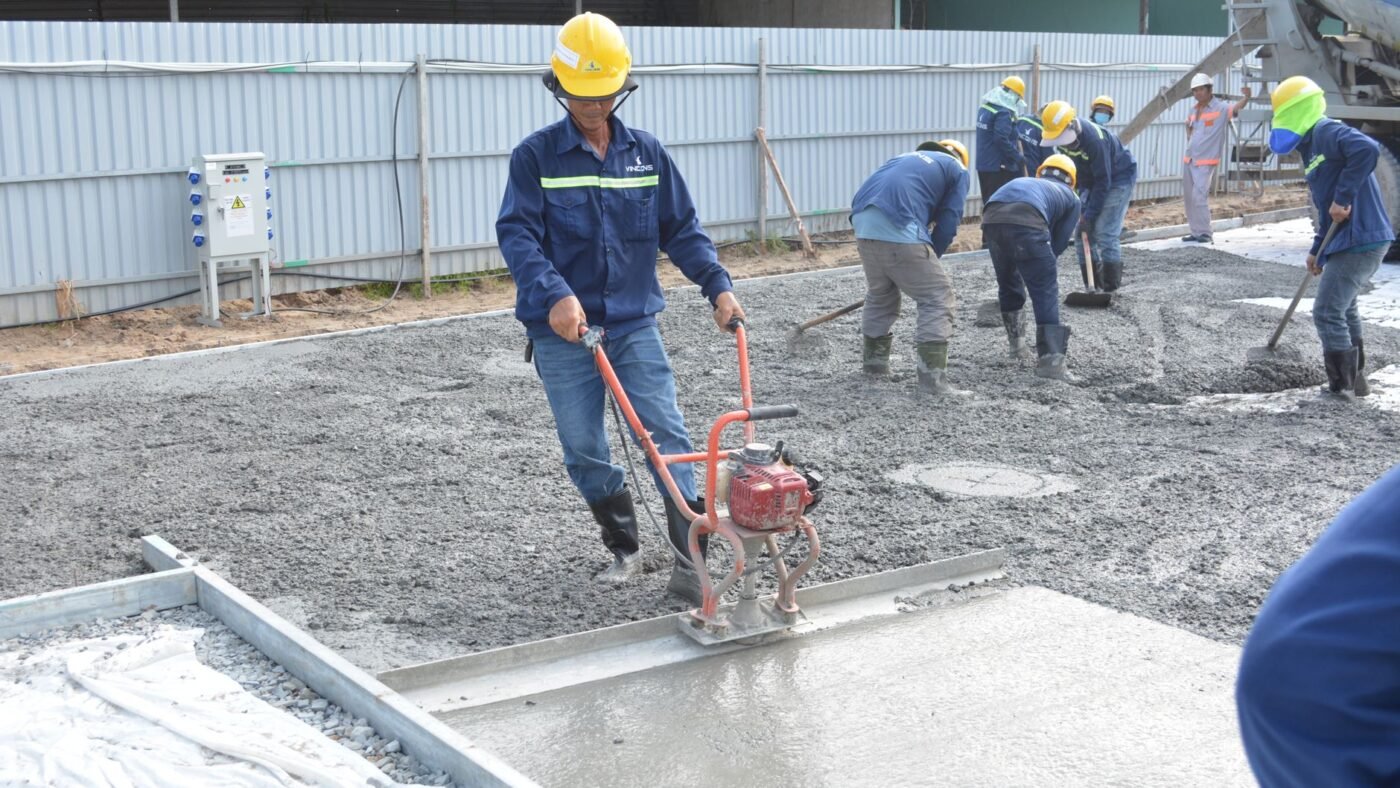
A soft cut saw is an early-entry concrete saw, built for the awkward hours when a new slab is too hard to trowel and too soft to trust. It cuts control joints within a few hours of finishing, while the concrete is still "green" and before shrinkage cracks can form on their own. Unlike a conventional wet saw, it cuts dry and upward, and a skid plate holds the surface down so the fresh edges don't tear. NRMCA guidance puts early-entry cuts at 1 to 4 hours after finishing, at least 1 inch deep. Conventional saw cuts come later, at 4 to 12 hours.
The name comes from Soff-Cut®, Husqvarna's trademarked early-entry system; the industry uses "soft cut" loosely for any early-entry saw. If you pour concrete next to a paver patio or driveway, for an apron, a bordered slab or a base for pavers, this is the saw that controls where it cracks.
Why fresh concrete needs control joints
Concrete shrinks as it sets and dries. If the slab is restrained by the ground, the forms and whatever it touches, that shrinkage pulls it apart and it cracks. You can't stop the cracking. You can only decide where it happens.
The National Ready Mixed Concrete Association's CIP 6 on joints in slabs on grade describes joints as "pre-planned cracks", which is the most honest phrase I've read in a concrete document. A saw cut makes a weak line, and the crack forms neatly underneath it instead of wandering across the slab.
- Contraction (control) joints are the saw cuts or tooled grooves. They're what a soft cut saw makes.
- Isolation joints separate the slab from walls, footings, steps and other slabs, usually with a compressible filler strip. They're placed before the pour, not sawn.
- Construction joints are where one day's pour meets the next.
The risk comes from early shrinkage stress. A conventional saw waits until the concrete can take a wet blade and a heavy machine, and on a hot day the slab can crack first. Early-entry saws close that gap.
How a soft cut saw works
A soft cut saw is built to run on concrete you could have dented with a thumbnail an hour earlier. Several features set it apart from a conventional flat saw:
- Dry, up-cut blade. The blade turns so it cuts upward through the surface. Combined with dry cutting, that keeps the soft edges from being pushed down and torn out.
- Skid plate. A plate rides on the concrete right around the blade and holds the surface down at the cut, so the joint edges don't ravel (crumble). Blade suppliers treat the skid plate as part of the system and replace it on a wear schedule, often along with the blade.
- Light weight. Residential models are small walk-behind saws that won't mark green concrete; larger self-propelled ones handle warehouse floors.
- Shallow, fixed depths. Early-entry cuts are shallower than conventional ones. Retailer listings show Husqvarna's Soff-Cut range with cutting depths from about 1 to 4 inches, depending on the model.
- Matched blades. Early-entry diamond blades come in bonds matched to the aggregate. Hard aggregates such as chert or quartz need a softer bond. Abrasive mixes need a harder one. Many blades use a non-round safety arbor that fits only the matching saw.
Husqvarna describes its Soff-Cut saws as designed to cut "shortly after finishing while the concrete is still in its early curing stage". Other makers, including Norton Clipper and ROC Abrasives, sell early-entry saws or blades too.
When to cut: the green window
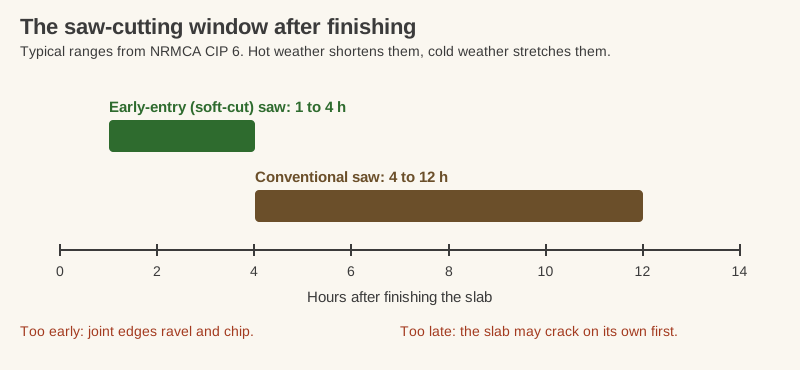
Timing is the whole point of a soft cut saw. Early is ravelled edges; late is a crack that got there first.
- Early-entry (dry) cuts: generally 1 to 4 hours after finishing is complete, depending on how fast the concrete sets (NRMCA CIP 6).
- Conventional saw cuts: within 4 to 12 hours after finishing (NRMCA CIP 6).
Husqvarna calls the right moment the "Green Zone": firm enough to walk on without leaving marks, still soft enough to cut cleanly. (Every manufacturer eventually trademarks a colour.)
How to judge it on site:
- Walk on it. If your boots leave prints, it's too early, and you've also signed the slab.
- Make a short test cut in an out-of-the-way spot.
- Look at the edges. If they ravel, with aggregate popping out and edges chipping, wait and try again. NRMCA notes that raveling means sawing "must be delayed", but also that waiting too long lets uncontrolled cracking start.
Weather changes the clock
The clock starts at finishing, but the concrete sets the pace:
- Hot, dry, windy days speed up setting. The window can open and close early, and shrinkage stress builds faster. Plan to have the saw on site and fueled before you finish.
- Cool days slow setting down. The window shifts later, and you may be waiting into the evening.
- Mix design matters too. Accelerators, retarders, fly ash and slag all shift set time, so ask the supplier what's in the load.
- Sun and shade on one slab can put parts of it in the window at different times. Cut the sunny side first.
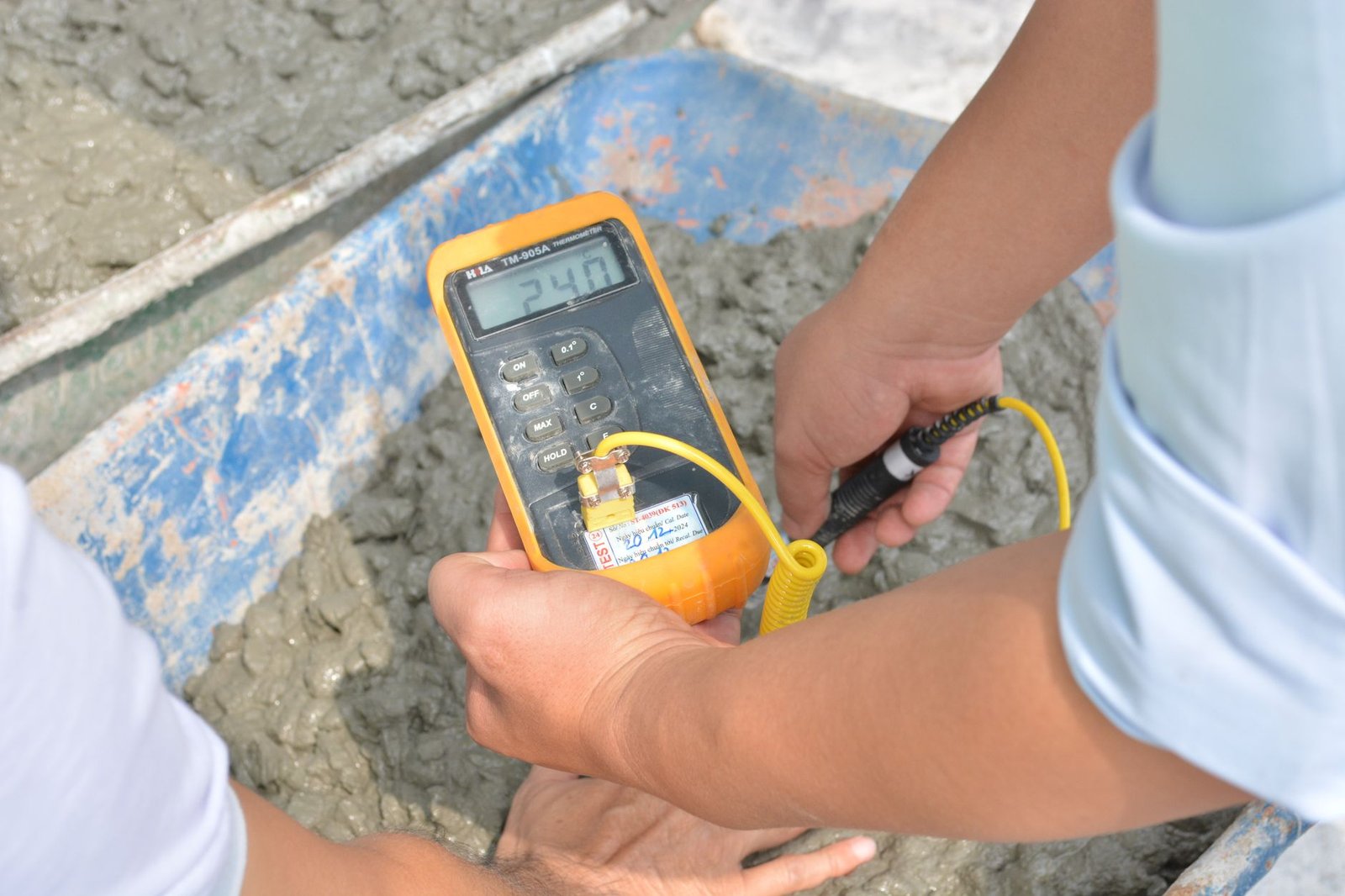
Checking concrete and air temperature helps predict a short afternoon window or a long wait.
How deep and how far apart
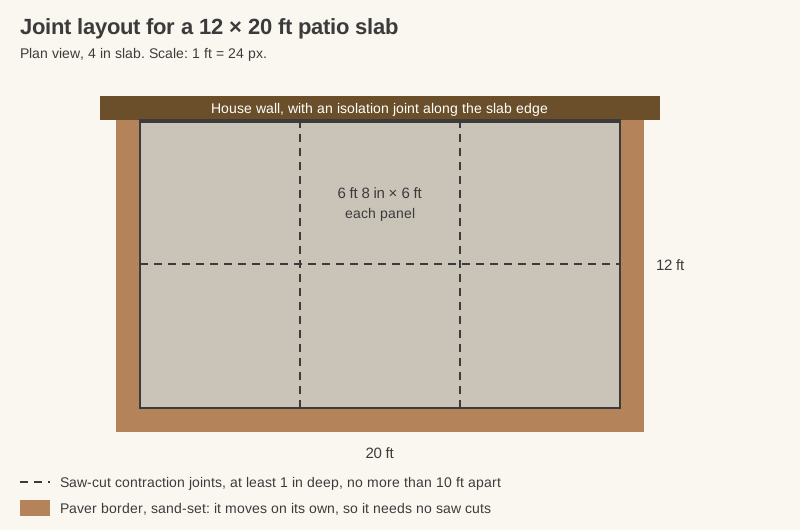
NRMCA CIP 6 gives rules of thumb for residential and general flatwork:
- Depth. Contraction joints should be at least 1/4 of the slab thickness, and never less than 1 inch. I read CIP 6 and Husqvarna's page side by side here, because they don't quite agree: Husqvarna says its ultra-early-entry joints are typically about 1/8 of the slab thickness, while CIP 6 keeps a 1-inch floor. On a 4-inch slab, a 1-inch cut satisfies both. If your job has a spec, follow it.
- Spacing. A maximum of 24 to 36 times the slab thickness. For a 4-inch slab, that's about 10 feet, and CIP 6 suggests never more than 15 feet.
- Panel shape. Keep panels square or nearly so, with the length no more than 1.5 times the width. Avoid L-shaped panels; cut from each inside corner.
- Wire mesh. Mesh doesn't prevent cracking. If it runs through the slab, CIP 6 recommends cutting alternate wires, or better, stopping the mesh at the joints.
Mark the joint lines on the forms before the pour, so the crew can cut quickly once the window opens.
Soft cut saws and slabs next to pavers
This is a paver site, so here's where a concrete saw fits into a paver project.
- A concrete patio with a paver border. The slab needs control joints like any other. The sand-set paver border moves independently and needs no cuts. Line the joints up with a paver course or border corner so the crack lines look planned. Our guide to a concrete patio with a paver border covers the border side.
- Driveway aprons and walks next to paver driveways. NRMCA recommends isolation joints where driveways meet walks, curbs, garage slabs and stairs. Plan those joints before the pour, and saw the control joints within the window.
- A new slab as a base for pavers. If you're pouring a slab to set pavers over, joint it properly. Cracks and joints in the slab below need attention when you lay pavers over them. See pavers over concrete.
- Wrong tool for cutting pavers. A soft cut saw is for green concrete only. To cut cured pavers, use a cut-off saw or a table saw with a diamond blade.
Renting, buying and running one
My honest view: on a single residential slab, don't buy this saw, and think hard before renting one. The window is 1 to 4 hours after finishing, which is exactly when the person who poured the slab is busiest. If a contractor is pouring, make saw cutting part of their price; they already own the saw, the blade matched to the local aggregate and the skid plates. Pouring it yourself? Rent one only if a second person can run it while you finish. Buying suits crews pouring flatwork weekly.
Before the pour:
- Confirm the saw, a spare blade and the matching skid plate are on site. Check the blade bond suits the aggregate in your mix.
- Mark the joint lines on the forms.
- Plan the order: sunny areas and the longest cuts first.
During the cut:
- Cut straight through to the slab edge, so the joint doesn't stop short and leave a restrained corner.
- Keep the skid plate flat and replace it when it's worn.
- Dry cutting concrete makes fine dust. Use the saw's dust controls where fitted, and wear eye, hearing and respiratory protection.
After the cut:
- Keep curing the slab as planned. The saw cut doesn't replace curing.
- If a crack has already formed before you get there, don't cut a joint alongside it. Let the crack act as the joint and adjust the nearby layout.
Cut early, cut straight, cut deep enough
A soft cut saw doesn't stop concrete from cracking. It gets a planned joint in before the slab has a chance to crack on its own. Cut 1 to 4 hours after finishing, as soon as the surface stops raveling. Go at least 1 inch deep, keep panels near-square, and space joints at no more than about 10 feet on a 4-inch slab. On a paver project, joint the slab properly and give the pavers their own movement. Concrete will always crack; the saw just lets you pick the spot, which is the closest thing to winning an argument with it.
FAQ
What is the difference between a soft cut saw and a regular concrete saw?
A soft cut (early-entry) saw cuts dry, upward and shallow, and uses a skid plate to protect the edges. That lets it cut within 1 to 4 hours of finishing. A conventional wet saw needs harder concrete and usually cuts 4 to 12 hours after finishing, making deeper cuts.
How soon can you cut concrete with a soft cut saw?
As soon as the slab can be walked on without leaving marks and a test cut shows no raveling. NRMCA puts this at generally 1 to 4 hours after finishing, depending on the mix and weather.
How deep should a soft cut be?
NRMCA calls for a minimum of 1 inch for early-entry cuts, and at least 1/4 of the slab thickness for contraction joints in general. On a typical 4-inch patio or walk, 1 inch is the working depth.
How far apart should control joints be in a 4-inch slab?
About 10 feet, based on NRMCA's 24 to 36 times slab thickness rule. Keep each panel close to square, with the length no more than 1.5 times the width.
Can you cut control joints the next day?
It's risky. By then shrinkage stress may already have cracked the slab at random; cracks often start within the first day, which is why early-entry saws exist.