Last Updated on September 23, 2026 by Umar Farooq
The best paver walkway designs follow the route people actually walk, stay wide enough for two people side by side at the front door, and use one or two design moves (a gentle curve, a landing, a contrasting border) rather than all of them at once. Pick the route first, then the width and shape, then the paver, pattern and edge detail. The mail carrier has already voted on the route, by the way. Check the lawn.
This covers the design side: routes, shapes, borders, materials, patterns and lighting. For the dig, base, slope and edging, follow the paver walkway installation guide.
Paver walkway designs start with the route
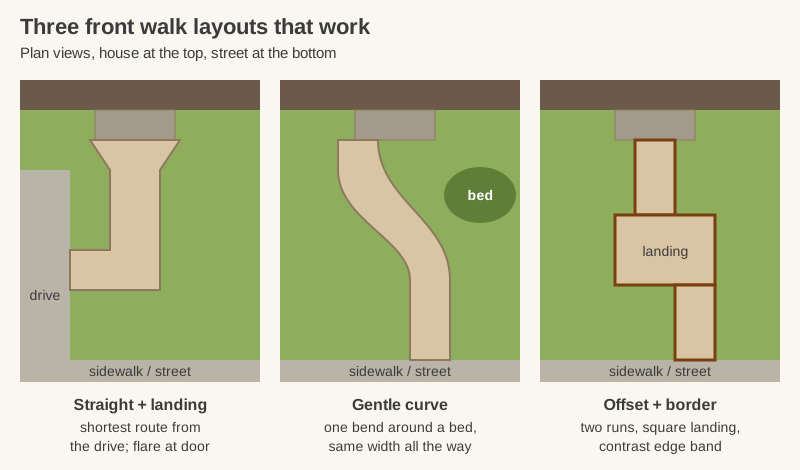
Before thinking about pavers, decide where the walk starts, ends and how people really move along it.
- Driveway to front door. Most guests arrive by car, so for many houses this is the walk that gets used most. A walk that only runs from the street sidewalk may look classic and still be ignored.
- Street to front door. Classic and symmetrical, and a strong choice when the house is set well back or there is on-street parking.
- Side yard and garden paths. Link the front to the back, the patio to a shed, or a gate to the vegetable beds. These can be narrower and more informal.
Watch for shortcuts. If the route makes people walk an extra 10 feet around a bed, they will cut across the lawn and wear their own path. Nobody has ever lost this argument to a lawn. Design the walk along the line of desire, and use planting, not a detour, to make it interesting.
Width and proportion for a front walk
A front walk should feel generous. The installation guide recommends at least 36 inches for a path and 48 inches at a front entry, where two people often walk side by side. Garden paths used by one person at a time can go narrower.
Width is a design tool too:
- Match the entry. A walk narrower than the stoop or door surround looks pinched. Aim for at least the width of the landing it serves.
- Flare at the ends. Widening the walk where it meets the driveway and the stoop reads as a welcome and gives people room to step aside.
- Scale to the house. A large two-story house needs a wider walk than a cottage.
Once you pick the paver, adjust the width by an inch or two so the field fits between the borders without sliver cuts.
Curves that look natural, not forced
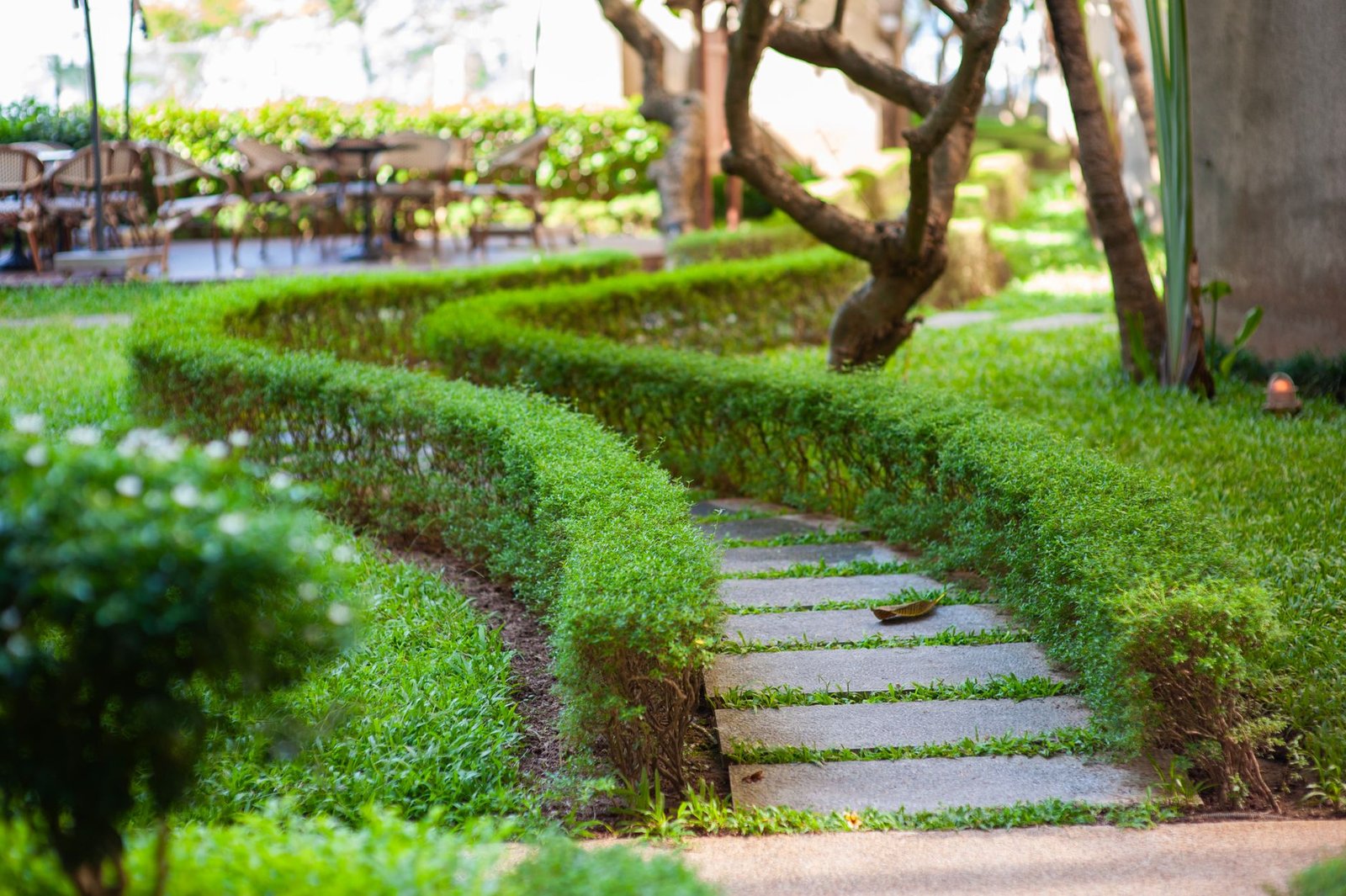
Curved walkway designs soften a straight lot and lead the eye into the garden. Belgard's walkway ideas gallery groups curved paths as their own style; I went through it counting, and curves outnumber straight walks by a fair margin.
A few rules make a curve look intentional:
- Give the curve a reason. Bend around a tree, a bed or a change in grade. A wiggle across an open lawn looks random.
- Use long, gentle arcs. One or two broad bends beat a series of tight S-curves. They are also easier to walk and much easier to cut.
- Keep the width constant. Measure across the walk every few feet when you lay out the curve, so it does not pinch in the middle of a bend.
- Lay it out with hoses. Two garden hoses for the edges let you walk the route and adjust it before any paint goes down. (This is the only time a tangled hose is useful.)
Every edge paver on a curve needs a cut, so a curved walk costs more than a straight one.
Landings, steps and offsets
A long straight walk can feel like a runway, minus the applause. Breaking it with a landing, a shift in direction or a step adds rhythm and makes practical sense.
- Square landings where the walk changes direction, where a side path branches off, or at the base of steps. A landing is a natural place for a planter or a bench.
- Offsets. Two straight runs, shifted sideways and joined by a landing, give a formal house a modern, architectural walk without curves.
- Steps on slopes. Where the ground rises steeply toward the house, a few wide steps with deep treads look better and feel safer than a steep ramp of pavers.
Keep landings at least as wide as the walk and, at the front door, large enough to stand on while the door swings open.
Borders and bands that frame the path
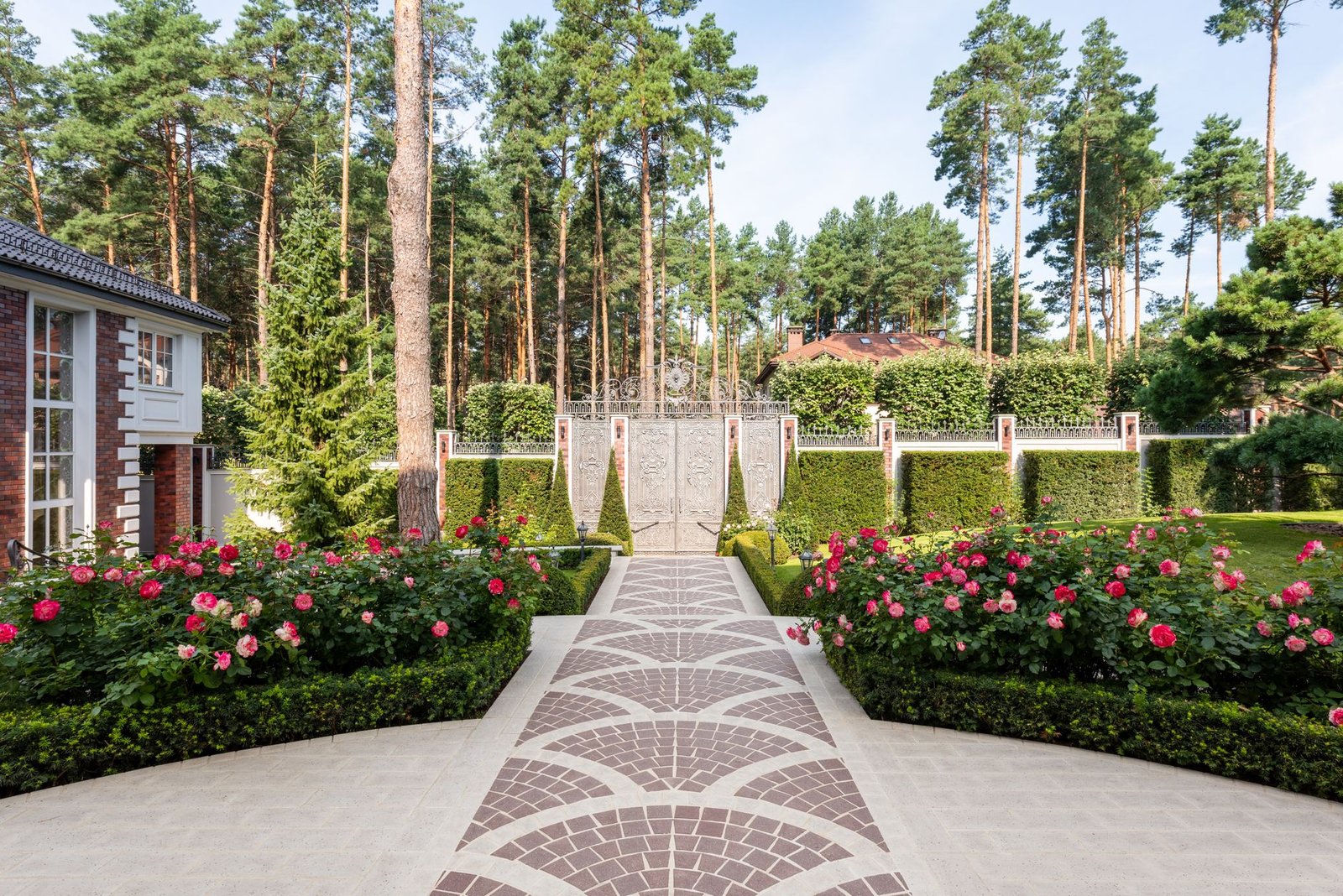
A border is the single most effective walkway paver idea. A row of darker or differently sized pavers along both edges frames the walk, hides edge cuts and makes a plain field look finished.
Popular options:
- Soldier course border (pavers set side by side across the edge) for a strong frame.
- Sailor course border (pavers end to end along the edge) for a slimmer line.
- Cross bands every few feet, in the border color, to break up a long walk and echo the lines of the house.
- Inset details, such as a medallion or a fan pattern at a landing.
Unilock's walkway design advice suggests contrasting borders and inset "paver rugs" for exactly this reason: they draw the eye toward the entrance.
Choosing pavers for walkways
Stone and concrete paver walkways dominate in most US neighborhoods, but the choice depends on the look and the climate:
| Material | Look | Notes for a walkway |
|---|---|---|
| Concrete pavers | any style, from tumbled cobble to smooth modern | durable, widely available, easy to match a patio |
| Clay brick pavers | traditional, warm red tones | color does not fade; suits colonial and Tudor houses |
| Natural stone (bluestone, flagstone, granite) | rustic or formal | premium look; check slip resistance when wet |
| Porcelain pavers | sleek, modern | needs a very flat base; choose a textured, outdoor-rated finish |
| Permeable pavers | similar to concrete pavers with wider joints | lets rain soak through; useful where runoff is a problem |
Match the walkway to the patio or driveway if they are visible together, or at least share a color. Two unrelated paver styles in one front yard look like two neighbours who haven't been introduced.
Texture matters on a walkway more than on a patio. Smooth, polished faces get slippery when wet or icy, so choose a textured or tumbled face for the main entry walk.
Patterns that suit a narrow path
A walkway is long and narrow, so the pattern changes how it looks:
- Running bond across the walk makes it look wider and slows the eye.
- Running bond along the walk makes it look longer and points toward the door.
- Herringbone looks formal and handles curves with fewer odd gaps.
- Basketweave suits traditional brick walks.
For how each pattern performs and how much each one cuts, see the full comparison of paver patterns.
Lighting, planting and the edges of the walk
The space beside the walk is part of the design.
- Lighting. Low path lights along one or both sides, or lights built into a border or step riser, make the walk safe after dark. Run the wiring or conduit before the base goes in.
- Planting. Low plants along the edges soften the line. Keep anything taller than about knee height back from the edge so it does not narrow the path when it grows.
- Mixed materials. Pavers with gravel shoulders, or large steppers in gravel, give a softer, cheaper walk for side yards. The guide to a paver walkway with gravel covers that style.
- Stepping stones. For a casual garden path, individual stones in lawn or mulch can be enough.
Let the route lead and keep the details simple
Good paver walkway designs are easy to walk before they are pretty. Put the walk where people already go, make it wide enough at the door, bend it only where something justifies the bend, and add one framing detail, usually a contrasting border. Choose a textured face for grip, and light it.
My one strong opinion: never build the front walk narrower than 48 inches. At 36, two people walk single file and one of them ends up on the lawn; the extra foot costs a few more pavers once and saves the grass forever.
Get the route right and the rest is decoration. Get it wrong and the lawn will tell you, one footprint at a time.
FAQ
What is the best paver for a walkway?
Concrete pavers suit most walkways because they come in every style, are durable and easy to match to a patio or driveway. Clay brick is a good traditional choice, and natural stone a premium one. Choose a textured face for grip.
How wide should a front paver walkway be?
At least 36 inches for a path, and about 48 inches at the front entry so two people can walk side by side. Match or exceed the width of the stoop it leads to.
Should a front walkway be straight or curved?
Straight suits formal and modern houses and short distances. A gentle curve suits informal houses and longer walks, especially when it bends around a tree or bed. Avoid curves with no reason behind them.
What pattern is best for a paver walkway?
Running bond is the easy choice and works for straight and gently curved walks. Herringbone gives a more formal look, and basketweave suits traditional brick.
Do paver walkways need a border?
Structurally, they need edge restraint, not a border. Design-wise, a contrasting border is the simplest way to make a walk look finished, and it hides the cut pavers along the edges.